ESA vs. a Regular Pet in California: What Actually Changes Under the Law (2026 Guide)
Maria got the letter from her landlord on a Tuesday. Her cat, Coco, had lived with her for two years without any incident, but the new property manager had just discovered she had never paid a pet deposit. “Coco isn’t a pet,” Maria told him. “She’s my emotional support animal.” He blinked at her like she’d spoken another language. Was she trying to dodge a fee, or was there actually a legal difference between her cat and the average tabby down the hall?
That confusion is exactly why this guide exists. This article explains ESA vs a Regular Pet in California, including pet rent, deposits, no-pet rules, HOA restrictions, and what the 2026 updates mean for renters.
What Is an ESA Under California and Federal Law?
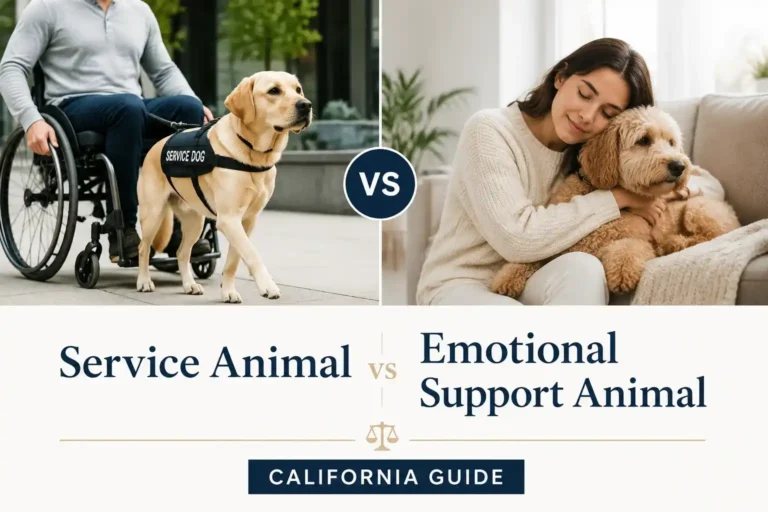
That last part matters. Unlike a service animal, an ESA does not have to learn a task. A dog trained to alert its owner before a seizure is a service animal. A cat that calms someone’s anxiety just by being present is an ESA.
California also has its own ESA rules. Assembly Bill 468, or AB 468, took effect on January 1, 2022. The law helps prevent people from getting same-day online ESA letters without a real evaluation. Only a licensed mental health professional can issue a valid ESA letter.
AB 468 requires an LMHP to establish a real client relationship for at least 30 days before writing an ESA letter. They must also complete a clinical assessment and include specific license details in the documentation.
The letter must also include the provider’s license number, license type, and jurisdiction. A letter from an online quiz completed the same day does not meet this standard and can be legally rejected by a landlord or HOA.
ESA vs. a Regular Pet in California: Main Differences
The key difference between an ESA and a regular pet in California is housing protection. A regular pet follows the landlord’s or HOA’s normal pet policy. An ESA with valid documentation may qualify as a reasonable accommodation in housing.
| Feature | ESA in California | Regular Pet |
|---|---|---|
| Main purpose | Offers emotional support related to a disability. | Gives companionship. |
| Special training | No task training needed. | Training is optional and personal. |
| Documentation | A valid ESA letter may be needed. | No medical documentation needed. |
| No-pet property | May be allowed as a housing accommodation. | Can be denied under a no-pet rule. |
| Pet rent and pet fees | Pet fees do not apply after approval as an accommodation. | Can be charged if the lease allows it. |
| Pet deposit | A pet deposit cannot be required only because of ESA status. | May be charged under the pet policy. |
| HOA rules | May require a reasonable accommodation review. | HOA pet rules apply. |
| Breed, size, or weight limits | Pet restrictions cannot be applied automatically without reviewing the request. | Can apply under normal pet rules. |
| Damage responsibility | The owner remains responsible for damage caused by the animal. | The owner remains responsible for pet damage. |
Also read: Can landlords charge monthly pet rent for an ESA?
Can a California HOA Deny Your ESA?
In most cases, no. A California HOA cannot deny your ESA just because it has a “no-pets” policy. If you have a valid ESA letter, the HOA must consider your accommodation request fairly.
An HOA generally cannot:
- Ban your ESA from the unit.
- Stop an ESA from using common areas that residents normally pass through, such as courtyards or shared walkways.
- Treat ESAs differently from other allowed animals without a valid reason.
Some areas, such as pools and clubhouses, can be more complicated. An HOA can restrict animals from pool decks for hygiene or safety reasons, as long as the rule applies fairly to everyone. The HOA board cannot treat ESAs differently while allowing other residents’ pets in the same area.
What an HOA can legally ask for:
- A valid ESA letter that meets AB 468 standards.
- Basic documentation showing that the ESA is part of a disability-related accommodation request.
What an HOA cannot legally ask for:
- Your specific diagnosis.
- Full medical records.
- Proof that your anxiety or condition is “severe enough”.
- Private details about treatment history.
The ESA letter is the evidence. The medical details behind it are private.
Where ESA Protections Do Not Apply: Public Places, Flights, and Workplaces

Many people misunderstand this part. ESA protections mainly apply to housing. An ESA letter does not give your animal the same rights as a trained service animal.
Public Places
Under ADA service animal rules in California, only trained service animals receive public access rights, while ESAs are mainly protected for housing accommodations.
That means places like:
- Restaurants
- Stores
- Hotels
- Cafes
- Malls
- Other public businesses
can usually refuse entry to an ESA.
Air Travel
Airlines can treat ESAs like regular pets.
Since 2021, an ESA letter does not guarantee free cabin travel for an emotional support animal.
Airlines may require:
- Pet fees
- Size limits
- A pet carrier
- Advance approval
- Standard pet travel rules
An ESA letter may support a housing request, but it does not guarantee free air travel.
The Workplace
ESA access at work depends on the employer and the situation. There is no automatic rule that allows every ESA in every workplace.
Your employer may review:
- Company policy.
- Your accommodation request.
- Workplace safety.
- Whether the request is reasonable.
In limited cases, an employer may allow an ESA as a reasonable accommodation, but it is not guaranteed.
Public access rights usually require a trained service animal or psychiatric service dog, not just an ESA letter.
What the 2026 HUD ESA Policy Shift Means for California Residents
The 2026 HUD memo created a major federal enforcement shift for emotional support animal cases.
On May 22, 2026, HUD’s Fair Housing Office issued new enforcement guidance for animal-related reasonable accommodation complaints. Under this guidance, HUD’s federal housing office will mainly focus on trained animals that perform disability-related work or tasks.
That means untrained ESAs may face a weaker path at the federal HUD complaint level.
What Changed at the Federal Level
Under the new approach, HUD is more likely to pursue cases involving:
- Trained service animals.
- Psychiatric service dogs.
- Animals that can perform specific tasks related to a person’s disability.
HUD is less likely to pursue complaints based only on:
- Emotional comfort.
- Companionship.
- General calming support.
- An untrained ESA letter alone.
In simple terms, HUD is now leaning closer to the ADA-style trained-task standard when deciding which animal-related housing complaints it will enforce.
What the HUD Memo Did Not Change
The memo does not mean ESA owners have no housing rights.
It does not:
- Repeal the Fair Housing Act.
- Automatically change California state law.
- Stop someone from filing a private fair housing lawsuit.
- Remove California’s own fair housing complaint process.
- Turn every ESA into a regular pet under California law.
This matters because HUD guidance is not the same thing as a statute passed by Congress or a California law passed by the state legislature.
What This Means for California ESA Owners
The main change is practical: a HUD complaint may no longer be the strongest path for an untrained ESA denial. That does not leave residents without options. State protections can still apply when a landlord, property manager, housing provider, or HOA refuses a disability-related accommodation request.
Can a Landlord or HOA Legally Deny an ESA?
Yes, but only in limited situations. A denial may be allowed if there is a valid legal reason.
A housing provider may be able to deny the request if:
- The resident does not provide reliable documentation after being given a fair chance to support the request
- The specific animal creates a direct threat to health or safety that cannot be reduced with reasonable steps
- The animal would likely cause substantial physical damage to the property that cannot be reasonably prevented
- Approving the request would create an undue financial or administrative burden
- The request would fundamentally change the housing provider’s operations
These decisions must be based on facts, not fear, assumptions, breed stereotypes, or general dislike of animals.
What to Do If You’re Denied
- Request the denial in writing, with the specific reason stated.
- Before submitting your ESA letter, confirm that it meets all AB 468 requirements. If anything is missing, ask your provider to update the letter first.
- File a complaint with California’s Civil Rights Department if you believe the denial was unlawful.
- Consider a HUD complaint as a secondary option, understanding that federal enforcement priorities shifted in 2026.
- Consult a California fair housing attorney if the property continues refusing a compliant request; many offer free initial consultations.
- Keep all emails, letters, and text messages related to the request in one folder from the beginning.
Is It Illegal to Misrepresent an ESA as a Service Animal?
Yes. In California, it can be illegal to misrepresent an ESA as a trained service animal. An ESA letter can support a housing accommodation request, but it does not give the animal the same legal status as a service dog.
State law treats false ESA claims seriously. Our earlier guide, ESA rules for California renters, explains the fines, misdemeanor risk, and California disclosure rules in detail.
Being honest about that difference protects you legally and helps preserve trust for people with genuine disability-related needs
Final Word
Coco stayed. I’ve seen this exact scenario play out again and again with California renters, and it almost always comes down to paperwork, not bad faith. Once Maria’s letter checked every AB 468 box and her landlord confirmed it with a quick call to the issuing provider’s office, the pet deposit came off the table, and the conversation ended.
That is really the whole story here: California gives real, specific protection to legitimate ESA owners, and it gives landlords and HOAs real, specific tools to say no to letters that do not meet the bar. Knowing exactly where that line sits protects everyone involved.
Frequently Asked Questions
Can my landlord make me renew my ESA letter every year?
Not automatically. A landlord should not demand a new ESA letter every year without a valid reason. However, updated documentation may be reasonable if the original ESA letter is old, unclear, or incomplete.
Is retaliation allowed after an ESA request?
No. A landlord should not punish, threaten, harass, or retaliate against a tenant for requesting a disability-related ESA accommodation. Examples may include eviction threats, rent increases, lease nonrenewal, or other negative actions tied to the request.
Can an ESA be denied for excessive barking?
Possibly. A landlord should not deny an ESA based on assumptions, but repeated noise complaints or documented nuisance behavior may create a valid housing concern. The issue should be based on documented behavior, not fear or stereotypes.
Are ESAs required to wear vests, badges, or tags?
Usually, no. ESAs are not required to wear special vests, badges, or tags for housing purposes. A valid ESA letter and proper documentation matter more than accessories.
Does an ESA still need vaccination or licensing records?
Yes. ESA status usually does not remove normal health and safety requirements. A landlord may ask for reasonable proof of vaccination, licensing, or animal-control compliance if those rules apply to other animals in the building.
Disclaimer: This content is for informational purposes only, not legal advice.