How Long Until Squatters Get Rights in California? What Property Owners Need to Know
Quick Answer: In California, a squatter gains tenant-like legal protections after 30 days of continuous occupation. To pursue full legal ownership through adverse possession, a squatter must occupy your property continuously for 5 years (or 3 years with color of title) while meeting 5 strict legal requirements, including paying property taxes.
Introduction
Imagine coming back from a two-month business trip to find a stranger living in your California rental property. The lights are on, there’s a car in the driveway, and someone answers the door when you knock. This is squatting, and it happens more often than most California property owners realize.
If you are searching for How Long Until Squatters Get Rights in California? You probably want clear answers before the situation spirals further. Understanding the timeline now can help you protect your property before small problems turn into legal headaches.
California has some of the most complex property laws in the country. The state’s squatter rights laws try to balance the rights of property owners with legal protections that can apply to people living in a property without permission. Understanding both timelines gives you the knowledge to protect your property and take the right action at the right time.
Here is a real-world discussion about California squatter rights and the challenges many property owners face.The Two Legal Timelines That Control Squatter Rights in California
Many California property owners confuse two completely different legal timelines when dealing with squatters. One timeline involves how quickly a homeowner can remove someone from the property. The other focuses on how long a squatter must stay before trying to claim legal rights.
Timeline 1: When California’s 30-Day Squatter Rule Starts
After just 30 days of continuous occupation, California law begins treating a squatter similarly to a legal tenant. This does not mean the squatter owns anything. It means you, the property owner, can no longer call the police and have them removed on the spot.
Under California Civil Code Section 1007, once someone has occupied a property for 30 days or more, a formal unlawful detainer eviction process becomes required. Trying to remove them yourself, cutting their utilities, or changing the locks without a court order is considered a self-help eviction in California.
That is illegal, and it can get you into legal trouble even if the person never had permission to live there.
This is where many California property owners get surprised. Acting quickly during the first 30 days can make the problem much easier to handle.
Timeline 2: California’s 5-Year Adverse Possession Rule
Under California Code of Civil Procedure Section 318, a squatter may be eligible to file a legal claim for property ownership after 5 continuous years of adverse possession.
This is much harder to prove. A squatter must meet all five strict legal requirements at the same time and continue meeting them for the entire five-year period.
Five years may sound like a long time, but vacant homes can become easy targets for squatters. Owners who rarely visit the property may miss the warning signs, allowing the situation to continue much longer.
Related: How Much Can a Landlord Raise Rent in California in 2026?
5 Legal Elements Squatters Must Prove in California
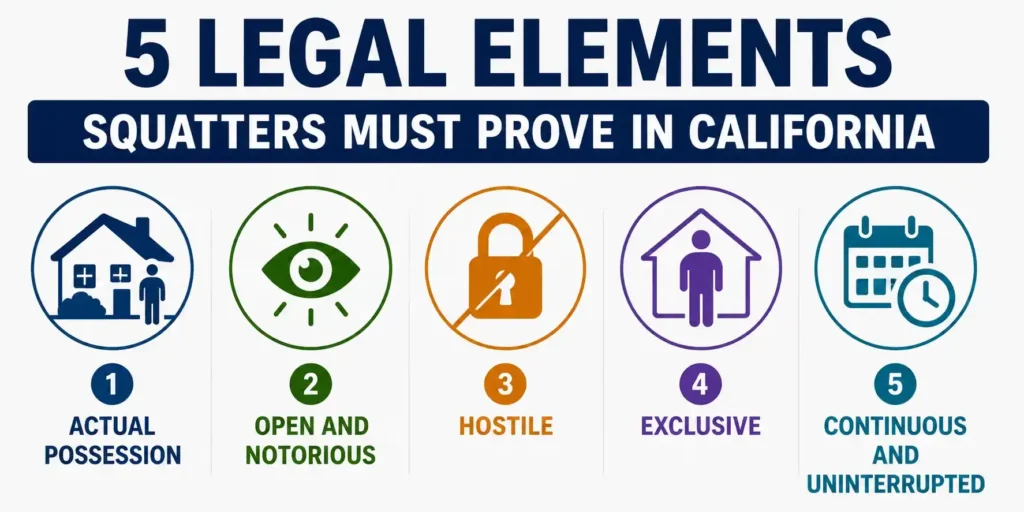
Courts carefully examine each element, and failing even one requirement can destroy the entire claim. Here are the five legal elements California courts look for.
- Actual Possession: The squatter must physically use the property. This means living there, maintaining it, making repairs, or using it in a way consistent with ownership. Simply parking a car on the property once a week is not enough.
- Open and Notorious: The occupation must be visible. A reasonable property owner driving by should be able to see that someone is living there. Hiding on the property does not qualify.
- Hostile: The occupation must be without the owner’s permission. If you gave someone verbal permission to stay, even casually, the ‘hostile’ element fails. This is why any informal arrangement should always be documented in writing.
- Exclusive: The squatter cannot share possession with the owner or the general public. The occupation must reflect individual control over the property.
- Continuous and Uninterrupted: The squatter must remain on the property for the full five-year period. Extended absences, especially those over 30 days, can break continuity and restart the clock.
Courts in California take these requirements seriously. Proving adverse possession requires substantial legal documentation, including records of tax payments, photos, utility bills, and witness testimony. Even then, there is no guarantee the court will rule in the squatter’s favor.
Related: Can a Landlord Keep My Security Deposit in California?
The Color of Title Rule: 3-Year Adverse Possession Rule
Under California Code of Civil Procedure Section 322, if a squatter has a “color of title” claim and pays property taxes, they may need only three years, rather than five, to pursue adverse possession rights.
A color of title means the squatter has paperwork that appears to grant them ownership, even though the document is legally invalid. This can happen with fake deeds, incorrect property transfers, or ownership records filled with mistakes. Some lease-to-own scams also create this type of false paperwork.
If someone moves into your vacant California property using fake or defective ownership papers, pays the property taxes for three years, and meets the other legal requirements, they may try to claim ownership in as little as 36 months.
This is rare, but it can happen with empty land and abandoned properties in rural areas of California.
Related: How to Fight an Eviction Notice Without a Lawyer in California
Squatter vs. Trespasser in California: Key Legal Differences
California law draws a clear line between a squatter and a trespasser. Understanding the difference determines how you can legally respond and how quickly you can remove someone from your property.
A trespasser under California Penal Code Section 602 is someone who enters or remains on your property without permission, typically for a brief period.
A squatter, on the other hand, occupies the property with the intent to remain. That distinction is enormously important for California property owners.
| Factor | Squatter | Trespasser |
| Intent | Occupy long-term, may claim ownership. | Brief unauthorized entry, no ownership intent. |
| Typical duration | 30+ days. | Hours to days. |
| Removal method after 30 days | Formal eviction (unlawful detainer). | Police removal under Penal Code § 602. |
| Can claim ownership? | Yes, after 5 years (or 3 with a color of title). | No. |
| Legal protections after 30 days | Yes, treated closer to tenant status. | Minimal. |
| Criminal charge possible? | Primarily a civil matter. | Yes, criminal trespass. |
Related: Can a Landlord Enter Without Notice in California?
How Senate Bill 602 Changed California Squatter Laws
For years, California property owners faced a frustrating paperwork loop when dealing with squatters and trespassers. If you wanted law enforcement to remove someone from your property, you had to file a trespass authorization letter with your local sheriff’s department every 30 days. Miss the renewal deadline by a single day, and you have to start over completely.
Senate Bill 602, which took effect on January 1, 2024, changed that significantly. Here is what it means for California property owners today:
- Trespass letters are now valid for one full year rather than only 30 days, helping owners avoid long-term legal problems.
- Electronic filing is now allowed, making the process faster and easier to manage.
- For closed or clearly posted vacant properties, authorization can now last up to 3 years, giving owners more protection and less paperwork.
- If a previously removed squatter returns to your property during the active period, law enforcement can remove them immediately without requiring you to file a new letter.
This law represents legal improvement for California property owners dealing with unauthorized occupants in recent years. If you own a vacant rental property, filing a trespass letter under SB 602 proactively is one of the smartest steps you can take right now.
Debunking the California 30-Day Squatter Rights Myth
Ask almost anyone in California what squatter’s rights mean, and you will hear the same thing: ‘After 30 days, the squatter owns the place.’ This is one of the most persistent legal myths in the state, and believing it can cause property owners to panic and make costly mistakes.
Here is the truth: 30 days of occupation does not give a squatter any ownership rights whatsoever. What it does is trigger a procedural protection. The squatter receives certain legal protections under California eviction laws.
After 30 days, you can still remove a squatter, but you must use the legal eviction process instead of immediate police removal. This usually means giving written notice, filing an eviction case, and waiting for a court decision.
Also read: Contingency Lawyer
How to Evict a Squatter in California: Step-by-Step Guide
Once a squatter has been on your California property for more than 30 days, you must follow a specific legal process. Skipping any step exposes you to liability and delays the removal. Here is exactly what to do:
- Confirm the situation: Document that the occupant has been there for 30 or more days. Take dated photos, note any utilities connected to the property, and keep records of your own attempts to contact them.
- Serve a written Notice to Quit: In most squatter situations, you serve a 3-day Notice to Quit. This legally demands that the occupant leave the property within three days. The notice must be properly served according to California law, either personally, by substituted service, or by posting and mailing.
- File an Unlawful Detainer lawsuit: If the squatter does not leave after the notice period, you file an unlawful detainer lawsuit with your local California Superior Court. The filing fee is generally under $500.
- Serve the summons: The squatter must be formally served with the court summons. They have 5 business days to file a written response with the court.
- Attend the court hearing: If the squatter does not respond, the court typically issues a default judgment in your favor quickly. If they do respond, a hearing is scheduled, usually within 20 days.
- Obtain a Writ of Possession: After winning your case, you request a Writ of Possession from the court. This permits the sheriff to force the squatter to leave.
- Sheriff enforces removal: The county sheriff posts a notice giving the squatter 5 days to leave voluntarily. If they do not leave, the sheriff carries out the removal.
For uncontested cases, the full squatter eviction process in California typically takes between 3 and 8 weeks from filing to removal. Contested cases can take 2 to 6 months, depending on court schedules and the complexity of the dispute.
Squatters and tenants are treated very differently under California law. While squatters must meet strict legal requirements to claim rights, tenants may continue to enjoy legal protections when a landlord sells a rental property.
How to Protect Your California Property From Squatters
The best way to deal with squatters in California is to prevent them from getting established in the first place. These steps are especially important for landlords who own vacant rental properties, vacation homes, or investment properties in California cities.
- Post “No Trespassing” signs clearly on all sides of the property. This is a prerequisite for enforcement under California Penal Code Section 602.
- File a proactive trespass letter with your local California sheriff’s department under Senate Bill 602. It is effective for one year and allows faster removal of unauthorized occupants.
- Inspect your property regularly and document each visit with dated photographs. Courts care about evidence, and regular inspection records establish that you actively monitored your property.
- Secure all entry points, lock every door and window, board up broken access points, and consider a smart lock or camera system for remote monitoring.
- Keep utilities in your name, even for vacant properties. Active utilities show ongoing ownership and control.
- Document every rental or occupancy arrangement in writing, even informal ones.
- Pay your property taxes on time. One of the required elements of adverse possession is that the squatter pays taxes during the occupancy period. Staying current on your taxes does not stop squatters from paying them, too, but it strengthens your ownership record in court.
- Consider hiring a California property management company to oversee vacant properties.
Also read: Metformin Lawsuit Explained
What Rights Does an Occupant Have in California?
Not everyone searching for information on California squatter’s rights is a property owner. If you are someone currently occupying a property without a formal lease and you want to understand your legal standing, here is an honest breakdown.
- After 30 days, a squatter may receive tenant-like legal protections.
- Property owners usually must use the court eviction process.
- These are legal protections, not ownership rights.
- Adverse possession requires strict legal conditions for five years.
- Most California adverse possession claims fail in court.
If you are in an uncertain housing situation, your best path is to consult with a California tenant rights attorney. Legal aid societies throughout California offer free consultations for low-income residents.
How California’s Squatter Laws Differ From Other States
California’s 5-year adverse possession requirement is actually among the shortest in the country. Many states require significantly longer periods before a squatter can pursue an ownership claim.
| State | Years Required | Notes |
| California | 5 years (3 with color of title) | Must pay property taxes, one of the shortest in the US. |
| New York | 10 years | Strong squatter protections; major urban issue. |
| Florida | 7 years | Tax payment required. |
| Texas | 10 to 30 years | Shorter with the color of the title, or if taxes are paid. |
| New Jersey | 30 years | One of the longest requirements in the country. |
| Arizona | 10 years | 3 years if taxes are paid and the color of the title is held. |
Frequently Asked Questions About Squatter’s Rights in California
Can squatters change locks or utilities in California?
Some squatters illegally change locks or connect utilities to make the property appear occupied. This does not automatically give them ownership rights under California squatter laws. Property owners should avoid shutting off utilities themselves without legal guidance.
How Do Airbnb Guests Become Squatters in California?
Long-term Airbnb guests can sometimes gain tenant-like protections in California if they refuse to leave after an extended stay. In some cases, property owners may need the formal eviction process to remove them.
How Do Squatters Delay a Home Sale in California?
Squatters can delay or complicate a home sale by occupying the property during the selling process. Buyers and lenders often avoid homes involved in active eviction disputes. Property owners usually need to remove squatters before closing the sale.
Can squatters list your property online for rent?
Yes, some squatters illegally advertise occupied homes on Facebook Marketplace or Craigslist to scam renters. They collect deposits from innocent people using properties they do not own. These fake rental scams have increased in several California cities. Owners sometimes discover the fraud only after strangers arrive expecting to move in. Monitoring online rental listings can help spot scams early.
How Do Squatters Use Solar Panels or Generators to Stay Hidden?
Yes, some squatters try to avoid attention by using portable generators or solar power instead of connecting to official utilities. This can make vacant properties appear unused from the outside. Property owners may not notice illegal occupancy for a longer period because there are no obvious utility records.
Can squatters create fake HOA complaints against owners?
Some squatters file fake Homeowners Association (HOA) or neighborhood complaints to appear like real residents. This can confuse neighbors and delay suspicion, especially in California HOA communities. Owners should quickly investigate unexpected HOA notices.
Final Thoughts
Understanding How Long Until Squatters Get Rights in California starts with understanding two key timelines: legal protections and ownership claims.
If you own a rental property, a vacation home, or a vacant lot anywhere in California, do not wait for a problem to develop before you act. Post your signs, file your SB 602 trespass letter, inspect regularly, and know the steps you need to take if you discover unauthorized occupants on your property.
And if you are already dealing with a squatter situation in California, consult a licensed California real estate attorney immediately. Every day you wait adds time to a clock that you want to stop as quickly as possible.
LEGAL DISCLAIMER: This article provides general legal information only and does not constitute legal advice. Laws can change. Always consult a licensed California attorney for guidance specific to your situation.
Also read: Can a Narcissist Win Custody in California?