How to Fight an Eviction Notice Without a Lawyer in California Legally
What if the eviction notice sitting on your kitchen table is not even legally valid? That is not a hypothetical. I have been through this myself, and I know how quickly fear and uncertainty can take over when you receive that notice. How to fight an eviction without a lawyer in California starts with understanding that the document in your hand may already have cracks in it.
Many California renters receive eviction notices every single month. Most of them assume they have no choice but to pack up and leave. That assumption is wrong. You have California tenant rights in 2026 that give you real power at every stage of this process, and you do not need to hire an attorney to use them.
This guide breaks everything down step by step in plain English, without confusing legal terms or pressure tactics. You will learn what to do next, what mistakes to avoid, and how to protect your home during this process.
Watch this quick video before you move forward.
What an Eviction Notice Really Means
An eviction notice in California is not a court order. It is a formal warning that starts the legal eviction process. California law gives you several chances to fight back during the eviction process, and those legal protections can seriously strengthen your position.
The 4 Types of Eviction Notices in California
Not every eviction notice works the same way. Knowing which type you received determines your options and your deadlines.
◌ 3-Day Notice to Pay Rent or Quit (CCP §1161(2)) Your landlord says you owe rent. You have three days to pay the full amount or move out. If you pay in full within those three days, the eviction stops. This is the most common type of notice California tenants receive.
◌ 3-Day Notice to Cure or Quit (CCP §1161(3)) Your landlord claims you violated a lease term, such as a pet you were not supposed to have, a noise complaint, or an unauthorized occupant. You have three days to fix the problem or face eviction.
◌ 3-Day Unconditional Notice to Quit (CCP §1161(4)) This is the most serious type. The landlord gives you three days to leave with no option to pay or fix anything. This is reserved for serious violations like illegal activity or significant property damage.
◌ 30 or 60-Day Notice to Terminate Tenancy (Civil Code §1946.2) Landlords usually use this notice in no-fault eviction cases, such as an owner move-in or removing the property from the rental market. If you have lived in the home for less than one year, you usually get 30 days to move out. If you have lived there for one year or more, you usually get 60 days.
If your landlord is selling the property, you may have additional legal protections beyond the eviction process. Learn more about tenant rights when a California landlord sells a rental home.
How Notices Must Be Served in California Under CCP §1162
A faulty eviction notice in California is not just about what it says. It is also about how it was delivered.
If your landlord slid the notice under your door, handed it to your neighbor without mailing a copy, or dropped it in your mailbox without attempting personal service first, the service was defective. Improper service is a complete defense in court.
California Code of Civil Procedure §1162 allows only three legal methods of service:
- Personal service: Handing the notice directly to the tenant in person.
- Substituted service: Leaving the notice with a person of suitable age at the residence and mailing a copy to the tenant the same day.
- Post and mail: Taping the notice to the unit door and mailing a copy, used only after reasonable attempts at personal and substituted service have failed.
Related: Can a Landlord Enter Without Notice in California?
3 Situations Where Your Eviction May Be Illegal
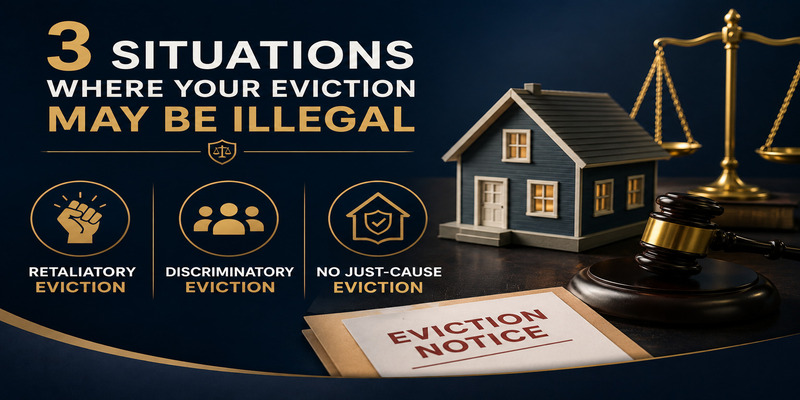
Even outside of AB 1482, California law protects tenants from three specific types of illegal eviction:
◌ Retaliatory eviction
Retaliatory eviction happens when a landlord sends an eviction notice because you exercised a legal right, complained about unsafe conditions, contacted a housing inspector, or joined a tenant union. California Civil Code §1942.5 makes retaliatory eviction illegal.
◌ Discriminatory eviction
Discriminatory eviction is illegal under both California and federal fair housing law. A landlord cannot evict you based on your race, national origin, religion, gender, disability, familial status, sexual orientation, source of income, or immigration status.
◌ No just-cause eviction
A landlord covered by AB 1482 cannot evict a tenant without a legally valid reason. If no just-cause reason exists, the eviction may be illegal.
Key Differences Between At-Fault and No-Fault Evictions
At-fault evictions happen when the landlord claims the tenant broke the lease, while no-fault evictions happen even though the tenant did nothing wrong.
To understand the difference more clearly, look at the table below.
| At-Fault Eviction | No-Fault Eviction |
|---|---|
| Usually starts after a tenant action. | Usually starts because of a landlord’s decision. |
| Often based on unpaid rent or lease violations. | Often based on owner move-in or property changes. |
| Focuses on tenant behavior. | Focuses on the landlord’s plans for the property. |
| Relocation assistance is usually not required. | Relocation assistance may be legally required. |
| The landlord must prove the tenant violated the lease. | The landlord must prove the legal reason for removing the tenant. |
Related: How Much Can a Landlord Raise Rent in California in 2026?
The California Eviction Timeline: Explained Day by Day
I know how overwhelming this process feels because I have seen how quickly people lose track of time once eviction papers arrive. The unlawful detainer timeline in California moves fast, and missing even one deadline can seriously damage your case.
Here is exactly how the process works from the moment you receive a notice:
⊙ Day 1: You receive the eviction notice. The clock starts immediately.
⊙ Day 3: The 3-Day Notice period expires. Weekends and court holidays do NOT count toward this deadline.
⊙ Days 4 to 7: If you have not paid, moved, or cured the violation, your landlord may file an unlawful detainer lawsuit with the court.
⊙ Days 7 to 12: The court serves you with a Summons and Complaint.
⊙ Days 12 to 17: You have exactly 5 BUSINESS DAYS to file a written response called an Answer.
⊙ Days 17 to 37: The court schedules your hearing, usually within 20 days of your Answer being filed.
⊙ Hearing Day: A judge hears arguments from both sides and issues a ruling.
⊙ If the landlord wins: The court issues a Writ of Possession.
⊙ Plus 5 Days: The sheriff posts a 5-day notice to vacate on your door.
⊙ After 5 days: The sheriff may enforce the lockout at any time.
Related: How Long Until Squatters Get Rights in California?
How to Fight a California Eviction Without a Lawyer
Fighting an eviction notice without a lawyer in California is not just possible; thousands of California tenants do it successfully every year. What separates the tenants who win from those who lose is almost always preparation, not legal expertise.
After that, follow these steps actively:
Step 1: Read the Notice and Document Everything
Before you do anything else, read your eviction notice from top to bottom and document every detail.
- Check the date on the notice and the date it was delivered.
- Confirm the reason stated for eviction matches an actual lease violation or unpaid amount.
- Verify the deadline given is legally correct for the type of notice.
- Photograph the notice, the envelope, and any door posting marks.
- Write down exactly how and when the notice was delivered to you.
Step 2: Identify Your Legal Defense
Every eviction has a potential defense. Your job right now is to identify which one applies to your situation.
Common eviction defenses in California include:
- Rent was paid: You have proof of payment, but the landlord is ignoring or disputing.
- Improper service: The notice was not delivered according to CCP §1162.
- Habitability issues: The landlord failed to maintain livable conditions, and you withheld rent lawfully.
- Retaliatory eviction: The notice followed your exercise of a legal tenant right.
- Discriminatory eviction: Protected class status is driving the eviction.
- AB 1482 violation: The landlord lacks a valid just-cause reason.
Step 3: File Your Answer Using Form UD-105
The Answer UD-105 is your formal written response to the eviction lawsuit. Filing it is the single most important action you can take. It tells the court that you are fighting the eviction and gives you the chance to present your side of the case.
You can download Form UD-105 for free at https://courts.ca.gov/forms-rules/court-forms and search for “UD-105.”
When filling it out:
- Check the box for each defense that applies to your situation.
- Use the “Other” section to add any specific details about your case.
- Sign and date the form.
If you cannot afford the filing fee, complete Form FW-001 (Fee Waiver Request) at the same time. Many California tenants qualify.
File your Answer at the Superior Court in the county where your rental property is located.
Step 4: Gather Your Evidence
After filing your Answer, build your evidence file. What you bring to court determines what the judge hears.
Collect every piece of documentation that supports your defense:
- Rent receipts, bank statements, or electronic transfer records showing payments made.
- Text messages, emails, or letters between you and your landlord.
- Photos or videos of uninhabitable conditions, such as mold, leaks, pest infestations, and broken heating systems.
- Code violation inspection reports from your city or county.
- Records of repair requests you made, and the landlord ignored.
- Any communication received after the landlord sent the notice, especially rent acceptance.
Organize everything by date. Label each document clearly. Present it in a simple folder you can hand to the judge without fumbling.
Step 5:Apply for Emergency Rental Assistance
If your eviction is based on unpaid rent, applying for emergency rental assistance can sometimes delay the eviction case. Many courts may delay the case once you show proof of a pending application.
You can visit housing.ca.gov to find current state and county assistance programs.
Step 6: Request Mediation Before Your Hearing
Many California courts offer free mediation programs specifically for eviction cases. Mediation puts you and your landlord in a room with a neutral third party who helps you reach a voluntary agreement without a judge deciding your fate.
Successful mediation can result in:
- A payment plan that lets you stay in your home.
- Additional time to relocate without an eviction judgment on your record.
- A conditional dismissal means the case goes away if you meet the agreed-upon terms.
- Reduced rent arrears in exchange for a structured move-out.
Ask the court clerk when you file your Answer whether mediation is available before your hearing date.
Also read: Can a Narcissist Win Custody in California?
What to Say During an Eviction Hearing in California
Walking into an eviction hearing without a lawyer feels intimidating. But California judges handle self-represented tenants in unlawful detainer hearings regularly. A calm, organized, fact-focused presentation will serve you far better than any legal performance.
What to bring on hearing day:
- Your original eviction notice and a copy.
- Your filed Answer UD-105 and a copy.
- All evidence is organized in a folder with labels.
- Three sets of everything, one for the judge, one for the landlord, and one for yourself.
- A valid photo ID.
- Write bullet points of your defense.
How to conduct yourself in court:
- Address the judge as “Your Honor” at all times.
- When the judge asks you to speak, stand up, state your full name, and clearly say you are representing yourself.
- Present your strongest defense first, then support it with your evidence.
- Speak slowly and stick to facts, dates, amounts, and documents.
- Do not interrupt when the landlord or their attorney is speaking.
- Do not make personal attacks or emotional arguments about your landlord’s character.
The judge mainly looks at whether the landlord followed the law correctly and whether you have valid evidence supporting your side of the case. Strong documentation, payment records, notice errors, or unsafe living conditions can all affect the final decision.
Related: Can a Landlord Keep My Security Deposit in California?
Free Legal Help for Eviction in California by County
You do not have to navigate this alone. California has one of the strongest networks of free legal help for eviction in the country, and most tenants never access it.
Statewide Free Resources
- California Courts Self-Help Center: selfhelp.courts.ca.gov free guides, forms, and court-specific information for every California county.
- California Rural Legal Assistance (CRLA): crla.org offers free legal services for low-income tenants, especially in rural and agricultural communities.
- LawHelpCA: lawhelpca.org statewide directory of free and low-cost legal aid organizations by county.
- 211 Housing Help: dial 2-1-1 from any phone to connect with local housing assistance programs and referrals
City-Specific Right-to-Counsel Programs
Several California cities now provide free lawyers for eviction defense through Right-to-Counsel programs:
- Los Angeles: The Right to Counsel Pilot Program provides free attorneys to income-qualified tenants in specific zip codes. Check housing.lacity.gov for current coverage areas.
- San Francisco: The Eviction Defense Collaborative provides free eviction defense services to income-qualified San Francisco tenants. Visit sfbar.org/ for referrals.
- Oakland and Alameda County: Bay Area Legal Aid provides free eviction defense services. Visit baylegal.org for intake information.
- San Diego: The Legal Aid Society of San Diego also offers free eviction assistance. Visit lassd.org.
Emergency Rental Assistance Programs
- Housing Is Key: housing.ca.gov California’s primary portal for state and federally funded rental assistance programs.
- County-specific programs: search “[your county] emergency rental assistance 2026” for the most current local programs.
- How to use a pending application in court: Bring your application confirmation number and submission receipt to every court appearance. Present it to the judge as evidence of active efforts to resolve the debt.
Read about contingency lawyers carefully so you can understand your legal options and make smarter decisions during your case.
Frequently Asked Questions
Can I stay in my home during the eviction appeal process in California?
Filing a Notice of Appeal after an unfavorable judgment does not automatically pause the eviction. To stay in your home during an appeal, you must separately request a Stay of Enforcement from the court and, in most cases, post a bond equal to the judgment amount. Low-income tenants can request a fee and bond waiver. If approved, sheriff enforcement is paused until the appellate court issues its decision.
What Is a Default Judgment in a California Eviction Case?
A default judgment happens when the tenant does not respond to the lawsuit on time. In that situation, the judge may automatically rule in favor of the landlord. The eviction process then moves forward much faster. Tenants can lose the chance to explain their side in court.
Can You Remove an Eviction From Your Record in California?
Some tenants may reduce the impact of an eviction on their rental history. Winning the case or reaching a dismissal can help protect your record. In certain situations, sealing or limiting public access to court records may also be possible. Every case depends on the outcome and court status. Responding early gives you more legal options.
Does paying partial rent stop an eviction in California?
No. A 3-Day Notice to Pay Rent or Quit requires full payment of the amount owed. Partial payment generally does not satisfy the notice requirement and does not legally stop the eviction process.
How Can You Spot a Defective Eviction Notice in California?
Common problems include incorrect deadlines, wrong rent amounts, missing legal information, or improper delivery methods. Some notices also fail to include the required just-cause language under AB 1482. Reviewing the notice carefully may help you identify important legal defenses early.
You Have More Power Than You Think
Receiving an eviction notice does not automatically mean losing your home. It means a legal process has started. The tenants who lose eviction cases are usually not the ones with the weakest legal positions. They are the ones who did nothing. They ignored the notice, missed the deadline, and walked away from a home they had every legal right to keep.
California tenant rights in 2026 are strong. The law gives you real tools, defective notice challenges, legal defenses, the right to a hearing, free mediation, emergency rental assistance, and a network of free legal aid resources. What you do with those tools in the next few days will determine what happens to your home.
If your situation is complex or you want personalized guidance, contact a licensed California tenant attorney or reach out to one of the free legal aid organizations listed in this guide.
Disclaimer: This blog provides general legal information for educational purposes only. It does not constitute legal advice and does not create an attorney-client relationship.
Also read: Metformin Lawsuit Explained: NDMA Risks, Cancer Concerns, and Latest Updates
Divorce in California: Who Gets the House