Can a Landlord Keep My Security Deposit in California?
You spent your final weekend cleaning the apartment because you wanted all the security deposit back. You vacuumed the carpets, cleaned the bathroom, patched small holes in the walls, and returned the keys, believing everything was in good shape. Then the landlord either stopped responding or sent an itemized deduction statement filled with repair and cleaning charges that made no sense to you.
Suddenly, a large part of your deposit is taken out because of damage you barely recognize. Many renters searching for “Can a Landlord Keep My Security Deposit in California?” are dealing with the same frustration right now. It feels even more unfair when you honestly tried to leave the property clean and well-maintained.
The good news is that California tenant security deposit rights strongly protect renters against unfair deductions, especially when landlords charge for normal wear and tear, inflate cleaning costs, or fail to follow the proper legal process.
Can a Landlord Keep My Security Deposit in California?
Yes, a landlord can keep a security deposit in California, but only under specific legal conditions. Under California Civil Code Section 1950.5, a landlord may deduct certain costs tied to unpaid rent, repair expenses, or excessive cleaning needs.
Outside of those categories, the deposit legally belongs to the tenant. California law treats a security deposit as the tenant’s property from the moment it is paid. The landlord can hold those funds in trust until the tenancy ends.
California courts have consistently treated security deposit returns as the default expectation. Withholding funds requires documentation, valid justification, and strict compliance with the 21-day deadline. Without all three, a landlord’s case falls apart in court.
Related: How Long Until Squatters Get Rights in California?
California Security Deposit Changes Under AB 12
If you signed a lease after July 1, 2024, there is a critical legal update that affects how much your landlord could legally charge you. California AB 12 changed the security deposit limit more significantly than any law in recent decades.
Before July 1, 2024, California landlords could charge up to two months’ rent as a security deposit for unfurnished units and three months’ rent for furnished units. For many tenants, that meant paying thousands of dollars before they could even move into the property.
Someone renting a $2,500 apartment could easily face a $5,000 deposit before even unpacking their first box. The new California security deposit law changed that by placing much stricter limits on how much landlords can now collect.
Related: How Much Can a Landlord Raise Rent in California
The New One-Month Security Deposit Cap Under AB 12
California now limits most security deposits to just one month’s rent for both furnished and unfurnished units. For many renters, this change made moving into a new home far more affordable by reducing high upfront costs.
Whether your landlord rents you an empty studio or a fully furnished apartment, the California security deposit cap is the same.
Here is the small landlord exception under the updated security deposit law:
- Some small landlords can still collect a larger security deposit under California law. If a landlord owns no more than two residential rental properties with a total of four or fewer units, they may charge up to two months’ rent as a security deposit.
- The owner must be a private citizen, a family trust, or a Limited Liability Company (LLC) where every member is a real person.
- Large corporate landlords and property management companies cannot use this exception under California law.
If your landlord charged you more than one month’s rent after July 1, 2024, and they do not qualify for the small landlord carve-out, they likely violated the California security deposit law of 2024. That matters when you dispute deductions or pursue a refund.
Related: How to Fight an Eviction Notice Without a Lawyer in California
4 Legal Reasons a Landlord Can Withhold Your Security Deposit in California
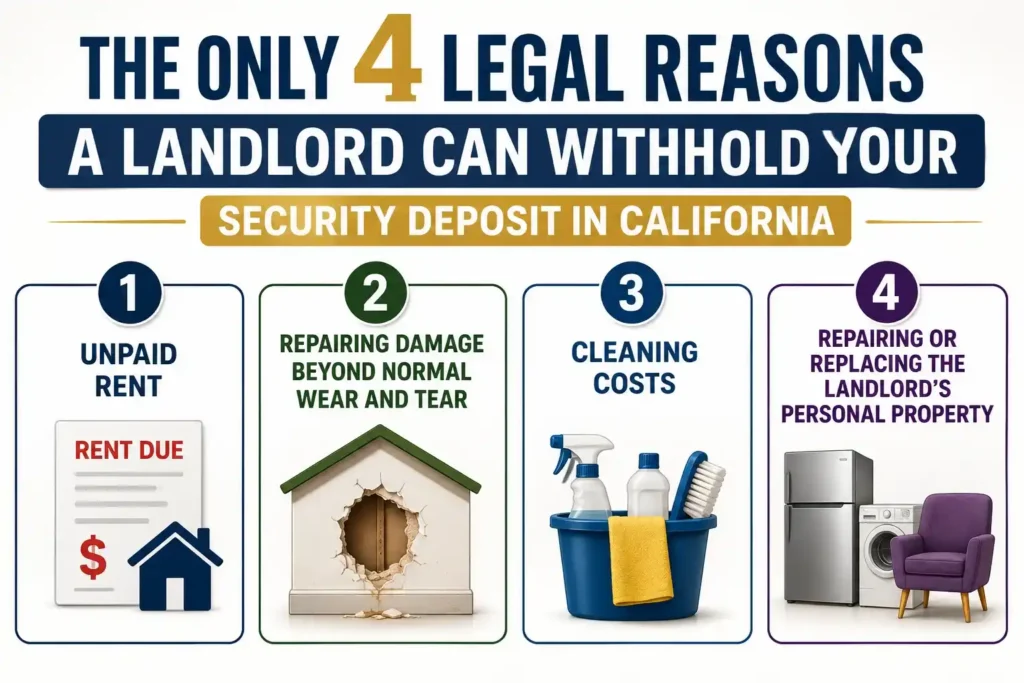
California law only allows landlords to use a security deposit for four specific reasons. Any charge outside those categories is considered an illegal security deposit deduction under California law.
1. Unpaid Rent
California law allows landlords to deduct unpaid rent, but important limits still apply:
- Your landlord can use your security deposit to cover unpaid rent when you move out, including a skipped final month’s payment or any unpaid balance from earlier in the tenancy.
- The landlord can only deduct the amount you truly owe, not extra or made-up charges.
2. Repairing Damage Beyond Normal Wear and Tear
Landlords may charge tenants for repairs resulting from damage beyond ordinary deterioration or natural aging of the property.
- The damage must be caused by you or your guests, not by ordinary aging, daily use, or problems that already existed before you moved in.
- Pre-existing damage remains the landlord’s responsibility, not the tenant’s. This is where many California security deposit disputes begin.
- Some landlords blur the line between real tenant-caused damage and everyday wear.
- Section four of this guide explains the difference with real-world examples.
3. Cleaning Costs
A landlord can only charge for cleaning needed to make the unit as clean as it was when you first moved in.
- If the apartment was reasonably clean when you moved in, leaving it in a similar condition usually satisfies your obligation.
- Landlords cannot charge for professional deep cleaning simply because they prefer a higher standard.
- They also cannot use your security deposit to make the unit cleaner or better than it was when you moved in.
- California courts have repeatedly rejected inflated cleaning deductions based on these rules.
4. Repairing or Replacing the Landlord’s Personal Property
California law also allows limited deductions for certain landlord-owned items included in the rental agreement:
- If your rental agreement included furniture, appliances, or other items provided with the unit, the landlord may deduct repair costs for tenant-related damage.
- This rule only applies if the rental agreement clearly mentions those items.
- If the lease does not mention personal property, the landlord usually cannot make this type of security deposit deduction.
| Note: California landlords cannot deduct administrative fees, re-listing costs, inconvenience charges, or early lease penalties from a security deposit. |
Normal Wear and Tear vs. Real Damage: Real Examples California Tenants Need
Normal wear and tear refers to the gradual, unavoidable deterioration that happens through reasonable daily living. This section gives you specific, real-world examples that reflect how California courts evaluate security deposit deductions.
| Normal Wear and Tear (NOT deductible) | Real Damage (Landlord CAN deduct) |
| Carpet: light traffic marks, slight color fading. | Carpet: pet urine stains, large burns, deep tears. |
| Paint: minor scuffs, fading from sunlight over the years. | Paint: large holes, unauthorized color changes, crayon marks. |
| Walls: small nail holes from framed pictures. | Walls: large gouges, graffiti, water damage from neglect. |
| Doors: worn handles from daily opening and closing. | Doors: broken hinges, holes punched through the door. |
| Appliances: minor surface scratches from regular use. | Appliances: broken knobs, shattered glass doors from misuse. |
| Bathroom: light soap scum, worn caulk along edges. | Bathroom: mold from neglect, cracked tiles, broken fixtures. |
| Windows: broken glass panes, damaged frames, or screens. | Windows: broken glass panes, damaged frames, and screens. |
Related: Can a Landlord Enter Without Notice in California?
The 21-Day Security Deposit Return Law in California
California gives your landlord an exact deadline. Within 21 calendar days of the date you vacate the unit, your landlord must either return your full security deposit or return any remaining deposit after legal deductions. along with a detailed written statement.
Landlords who miss this deadline, even by a single day, risk losing the right to keep any portion of your deposit regardless of the unit’s condition. Courts treat a missed security deposit return deadline as a serious violation, and it often leads directly to a bad-faith finding.
What the Itemized Statement Must Include
If your landlord keeps any portion of your security deposit, their written statement cannot be vague. A charge without details does not meet the California legal standard. Every deduction must be specific and fully explained.
When total deductions exceed $125, the landlord must attach supporting documentation:
- Third-party work: actual invoices or receipts from the contractor, cleaning company, or vendor.
- Landlord-performed work: a written description of each task, the time it took, and the hourly rate charged.
- Materials purchased: receipts for every supply used in the repairs or cleaning.
All charges must reflect reasonable market rates. A landlord cannot use fake, expensive invoices or inflated repair charges as valid deductions.
Related: Contingency Lawyer Meaning
When Repairs Take Longer Than 21 Days
California law recognizes that some repairs cannot be finished within the 21-day deadline. In those cases, the landlord can send a good-faith repair estimate within 21 days and later provide the final listed statement and any remaining deposit within 14 days after the work is completed.
| Pro Tip: Send your new address to the landlord by email on move-out day. A digitally dated message helps prevent delays in returning your security deposit. |
Your Right to a Pre-Move-Out Inspection
Before you vacate, you have the legal right to request a walkthrough inspection with your landlord.
The following rights can help protect your security deposit:
- The inspection must take place within the final two weeks before move-out.
- You also have the right to attend the inspection with the landlord.
- During the walkthrough, the landlord must provide a written list of possible charges against your security deposit.
This allows you to fix issues before move-out and reduce possible deductions from your security deposit.
What Happens When a Landlord Keeps Your Security Deposit in Bad Faith
In California security deposit cases, “bad faith” means the landlord acted unfairly, dishonestly, or knowingly violated the law while keeping your deposit.
Under California Civil Code 1950.5, landlords can face serious penalties for wrongfully keeping a security deposit. If a court finds the landlord acted in bad faith, you may recover the amount they withheld plus up to twice that amount in additional damages. For example, if a landlord wrongly kept a $3,000 deposit, the court could award you as much as $9,000 total.
City-Specific Security Deposit Rules: Los Angeles, San Francisco, and Oakland
California security deposit laws apply statewide, but some cities give tenants even stronger protections. Renters in places like Los Angeles, San Francisco, and Oakland may have additional rights beyond standard California law.
Los Angeles Security Deposit Interest Requirement
Los Angeles has its own tenant protection framework under the Rent Stabilization Ordinance (RSO). Under Los Angeles Municipal Code Section 151.09, landlords usually must pay interest on security deposits held for more than 12 months. If your landlord kept your deposit for over a year and never paid interest at move-out, you may be owed additional money under Los Angeles law.
Not every unit in Los Angeles falls under the RSO. The Los Angeles Housing Department website has an address lookup tool where you can confirm whether your specific rental is covered.
San Francisco Security Deposit Interest Rules
San Francisco requires landlords to pay annual interest on security deposits under San Francisco Rent Ordinance Administrative Code Section 49.2. The San Francisco Rent Board sets the applicable interest rate every year. If your landlord held your deposit in San Francisco and never paid annual interest, that amount is owed to you at move-out.
San Francisco also offers free mediation through the Rent Board for security deposit disputes when tenants want to resolve the issue without going to court. This can be worth exploring before filing a small claims case.
Oakland Security Deposit Protections
Oakland’s Rent Adjustment Program provides protections for tenants in covered units and also requires landlords to pay interest on security deposits held for one year or more. The Oakland Rent Adjustment Program website lists current interest rates and allows you to verify whether your property is covered.
Special Situations: Breaking a Lease, Domestic Violence Survivors, and Military Tenants
Breaking a lease does not automatically mean losing your security deposit in California. Landlords cannot keep the deposit as a punishment for moving out early.
However, landlords may deduct real financial losses during vacancy periods if they actively try to find a new tenant, as required under California law.
Once a new tenant moves in, your rent responsibility usually ends. For example, if the unit is re-rented after two weeks, the landlord can typically charge only those two weeks of lost rent, not several extra months.
Domestic Violence Survivors and Security Deposit Protections
Under California Civil Code Section 1946.7, tenants who leave early because of domestic violence, sexual assault, stalking, elder abuse, or human trafficking receive special legal protection.
- If you or someone in your household experienced one of these crimes within the past 180 days, the landlord cannot use your security deposit as a lease-break penalty.
- Landlords also cannot charge future rent after you move out in these situations.
- To use this protection, tenants must provide written notice and supporting documents.
- Accepted documents may include a police report, protective order, or a signed statement from a counselor or victim advocate.
Active-Duty Military Service Members’ Security Deposit Rights
Military tenants have both federal and California-specific protections affecting their security deposits. Under the federal Servicemembers Civil Relief Act (SCRA), active-duty members can terminate a lease without penalty when they receive qualifying military orders, such as a permanent change of station or a deployment of 90 days or more.
Note: Under AB 12 security deposit rules, active-duty military tenants are protected by the one-month security deposit limit, even under the small landlord exception.
How to Get Your Security Deposit Back: Demand Letter to Small Claims Court
More than 21 days have passed, and your landlord either stopped responding, returned less money than expected, or sent questionable charges. At that point, California tenants usually have two options: sending a demand letter or filing a small claims case.
Step 1: Send a Formal Security Deposit Demand Letter
Before filing in court, send your landlord a written security deposit demand letter. California courts expect tenants to try direct resolution first. A strong demand letter also creates a documented paper trail that works in your favor if the case escalates to court.
Your California security deposit demand letter should clearly include:
- The rental property address and your official move-out date.
- The total security deposit amount you originally paid.
- The exact dollar amount you are demanding be returned.
- A specific explanation of why each deduction is invalid.
- A firm response deadline, typically 10 to 14 days from the letter date.
- Your current mailing address for the return of the funds.
Send it by certified mail with a return receipt requested. Keep a permanent copy. California Courts offer a free security deposit demand letter template at selfhelp.courts.ca.gov.
Step 2: File a Security Deposit Claim in Small Claims Court
If your landlord ignores your letter or refuses to return the deposit, you can file a small claims case in California without hiring a lawyer. The process is simple and usually faster than regular court cases.
Individual tenants can sue for up to $12,500 in California’s small claims court to recover a security deposit. If your claim and possible bad faith damages exceed that amount, you may need to file in civil court instead.
To file your security deposit small claims case in California:
- Go to the small claims court in the county where the rental property was located.
- Complete the SC-100 form (Plaintiff’s Claim and Order to Go to Small Claims Court).
- Pay the filing fee, typically $30 to $75, depending on the claim amount.
- Arrange for proper legal service of the court documents to your landlord.
Bring to your hearing:
- Your signed lease agreement.
- Proof of security deposit payment, such as bank records, receipts, or a canceled check.
- Move-in and move-out photos and videos with visible timestamps.
- Your demand letter and any response the landlord sent.
- The landlord’s itemized statement, if they provided one.
- All written communication between you and the landlord during the tenancy.
If the landlord acted unfairly, ask the judge for additional damages under California Civil Code Section 1950.5 and clearly explain why the landlord acted in bad faith.
Room-by-Room Move-Out Checklist to Protect Your Security Deposit
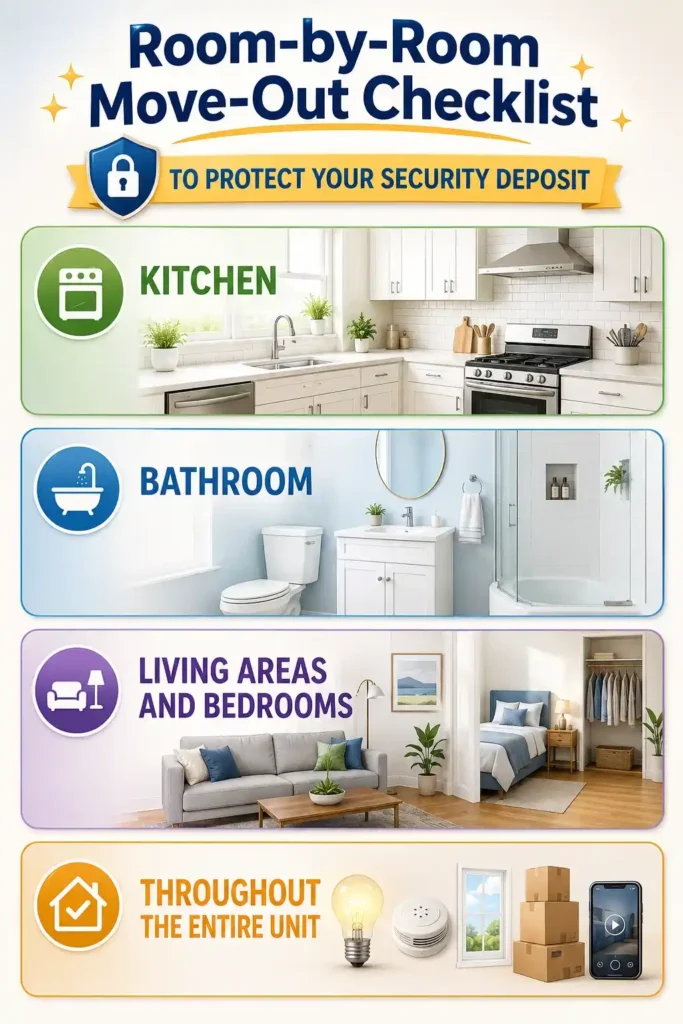
Use this checklist on your final cleaning day. Addressing every item before returning keys reduces the chance that your landlord can make a valid security deposit deduction.
Kitchen
- Clean inside and outside of oven, stovetop, and refrigerator completely.
- Wipe down all cabinet and drawer surfaces inside and out.
- Clean the range hood and replace the grease filter if needed.
- Remove all grease buildup from walls around the cooking area.
- Scrub the sink, faucet, and garbage disposal.
- Sweep and mop the floor thoroughly.
Bathroom
- Scrub the toilet, sink, bathtub, and shower walls completely.
- Remove all soap scum and mildew from tile and grout.
- Clean the mirror, vanity light bar, and exhaust fan cover.
- Replace the shower curtain liner if that was your responsibility under the lease.
Living Areas and Bedrooms
- Vacuum all carpets and steam clean any stains you caused.
- Clean baseboards, light switches, outlet covers, and door handles.
- Fill nail holes in walls with spackling compound and allow to dry.
- Wipe window sills, ledges, and blinds on every window.
- Clean inside all closets and remove every item you brought in.
- Remove all wall anchors and mounting hardware you installed.
Throughout the Entire Unit
- Replace every burned-out light bulb with a working replacement.
- Test all smoke detectors and carbon monoxide alarms.
- Clean windows from the inside and outside where safely accessible.
- Remove all belongings and trash from the unit and any storage areas assigned to you.
- Record your final continuous video walkthrough immediately before returning the keys.
Also read: Metformin Lawsuit
Frequently Asked Questions
What Should Tenants Do Before Renting a House in California?
Before renting a house in California, tenants should inspect the property, photograph existing damage, review the lease carefully, and keep written records from the beginning to help avoid future security deposit disputes.
What Should Tenants Do During a Tenancy in California?
During a tenancy, tenants should keep the property reasonably clean, report repair issues in writing, save payment records, and document any damage or maintenance problems to help protect their security deposit later.
Can I apply my security deposit to last month’s rent?
You can only use your security deposit for last month’s rent if your landlord agrees in writing beforehand. Without that agreement, the landlord may claim unpaid rent and still deduct money for valid move-out damages or cleaning costs.
Final Thoughts: California Tenants Have Real Power Here
If you have been searching “can a landlord keep my security deposit in California” with a knot in your stomach, here is what matters most: you have more protection than most landlords want you to know about.
California has some of the strongest security deposit laws in the country. Your deposit is your money. The law requires your landlord to return it on time, justify every deduction with documentation, and follow a strict legal process. When they fail at any of those steps, California security deposit law gives you real remedies, including bad faith damages that can double your recovery.
Document everything from move-in day. Know the four legal deduction categories. And if your landlord still refuses to follow the law, the California small claims court exists precisely for security deposit disputes like yours.
Disclaimer: This content is for general educational purposes only and is not legal advice. For serious California security deposit disputes, consider speaking with a licensed tenant rights attorney.
Also read: Mold-related habitability issues in California rentals
Can a Narcissist Win Custody in California?
References
- https://leginfo.legislature.ca.gov/faces/billNavClient.xhtml?bill_id=202320240AB12
- https://www.justice.gov/servicemembers
- https://lsnc.net
- https://leginfo.legislature.ca.gov/faces/codes_displaySection.xhtml?lawCode=CIV§ionNum=1950.5
- https://leginfo.legislature.ca.gov/faces/codes_displaySection.xhtml?sectionNum=1946.7&lawCode=CIV