How Much Can a Landlord Raise Rent in California in 2026? (Complete AB 1482 Guide + Calculator)
You got a rent increase notice in the mail. Maybe it was $200 more a month. Maybe it was $400. Your first reaction was probably the same as most Californians: Is this even legal? You Google it, land on three different articles, and walk away more confused than before.
Here’s the truth: figuring out how much a landlord can raise rent in California is not as straightforward as most people expect, because state law and local law do not always tell the same story. Some cities follow California’s baseline rules, while others have drawn their own stricter lines, and your rights depend entirely on which set of rules governs your front door.
Good news: California has some of the strongest tenant protections in the country. Under AB 1482, the Tenant Protection Act of 2019, many landlords cannot raise rent without following strict legal limits and statewide rules.
This guide covers everything you need to know about the California rent increase limit for 2026 from both the landlord’s and tenant’s perspectives. Whether you are a tenant trying to figure out if your landlord overcharged you or a landlord trying to stay compliant, this is the resource you have been looking for.
This video explains California rent increase laws, AB 1482 rent caps, local rent control rules, and the notice requirements landlords must follow.
How Much a Landlord Can Raise Rent in California in 2026?
Under California’s AB 1482 rent cap law, most landlords can only raise rent by a limited amount each year. In many cases, the increase is around 5% plus inflation, but state law usually blocks rent hikes above 10%. From August 2025 through July 2026, many California renters may see legal increases of about 6% and 9%, depending on where they live. Some cities have even stricter rules. For example, Oakland limits increases to 0.8%, while Berkeley limits them to 1.0%.
| Region | CPI Rate (2025-26) | Max Rent Increase |
| Bay Area (SF-Oakland-Hayward) | 1.3% | 6.3% |
| Los Angeles-Long Beach-Anaheim | 3.2% | 8.2% |
| Riverside-San Bernardino | 3.8% | 8.8% |
| San Diego-Carlsbad | 3.8% | 8.8% |
| Sacramento-Roseville | 3.1% | 8.1% |
| Oakland (local rent control) | N/A | 0.8% |
| Berkeley (local rent control) | N/A | 1.0% |
If the property is being sold, you may also wonder whether your rent can increase under new ownership. California’s rent increase laws can help you understand the limits that may apply to your rental unit.
What Is AB 1482 and Who Does It Protect?

California’s AB 1482 Tenant Protection Act became law on January 1, 2020. Governor Gavin Newsom signed it in response to skyrocketing rents across the state. Before this law, landlords in most California cities could raise rent by any amount they wanted between tenancies or at renewal, as long as they gave proper notice.
AB 1482 changed that. It introduced two major protections for qualifying renters:
- A cap on annual rent increases tied to inflation (CPI) plus 5%.
- Just cause eviction protections after 12 months of tenancy.
The law applies to most residential rental properties in California. But it does not cover every unit. Understanding whether your property falls under AB 1482 is the first step for both landlords and tenants.
Related: How to fight an eviction without a lawyer in California
Properties Covered by AB 1482
AB 1482 covers most apartments and multi-family buildings that are at least 15 years old. The 15-year rule is rolling, which means buildings that turned 15 this year just became subject to the law for the first time.
Here is what the law also covers:
- Single-family homes and condos owned by corporations, LLCs, or REITs (with proper notice given).
- Duplexes where the owner does not live on the property.
- Mobile homes in most circumstances.
Properties Exempt from AB 1482
Not every rental unit falls under the California rent control law. These properties are exempt:
- Buildings constructed within the last 15 years (rolling based on the current year).
- Owner-occupied duplexes where the landlord lives in the other unit.
- Single-family homes owned by individual landlords (not corporations or REITs), if they served the tenant with a proper written exemption notice.
- Condos owned by individual owners who provide the required exemption notice.
- Affordable and subsidized housing with deed restrictions.
- College dorms, student housing, and temporary stay hotels.
Important for landlords: If you own a single-family home but never gave your tenant the required written notice saying the property is exempt from AB 1482, the law may still apply to your property. Forgetting that notice can create serious legal problems.
Also read: How Long Until Squatters Get Rights in California?
How the AB 1482 Rent Cap Formula Works in 2026
The AB 1482 rent cap formula is simple once you know how to read it. Here is the calculation landlords must use:
Formula: Maximum rent increase = 5% + local CPI (April to April), capped at 10% total regardless of CPI.
The CPI used is the April-to-April change in the Consumer Price Index for All Urban Consumers for your metro area, published by the U.S. Bureau of Labor Statistics. The California Apartment Association updates its regional CPI calculator each June for the August 1 start of the new rent cap period.
Step-by-Step Calculation Example
Let’s walk through a real example so this is crystal clear.
Say you live in Los Angeles and your current rent is $2,000 per month. The LA metro CPI rate for 2025-26 is 3.2%. Here is how the maximum increase is calculated:
- Step 1: Start with the base: 5%
- Step 2: Add the local CPI rate: 5% + 3.2% = 8.2%
- Step 3: Check the ceiling: 8.2% is below 10%, so 8.2% is the max
- Step 4: Apply to rent: $2,000 x 8.2% = $164 maximum increase
- Step 5: $2,000 + $164 = $2,164 per month
- Result: Your landlord can charge no more than $2,164 per month
If your landlord tried to raise your rent to $2,300, that would be illegal. You would have grounds to dispute it and potentially recover the overpaid amount.
Historical California Rent Cap Rates
| Period | Regional CPI Rate | Max Increase |
| Aug 2021 – Jul 2022 | 4.1% | 9.1% |
| Aug 2022 – Jul 2023 | 5.0%+ | 10.0% (capped) |
| Aug 2023 – Jul 2024 | 5.0%+ | 10.0% (capped) |
| Aug 2024 – Jul 2025 | 3.6% | 8.6% |
| Aug 2025 – Jul 2026 | Varies by region | 6.3% to 8.8% |
Also read: Divorce in California
California Rent Control Cities 2026: Where Local Rules Apply
Many California renters do not realize this, and even some landlords miss it too: when a city has its own rent control law, those local rules usually override AB 1482. In many cases, local rent increase limits are much lower than the statewide cap.
This matters enormously. A landlord in Oakland might think they can raise rent by 6.3% because that is the AB 1482 statewide cap for their metro region. But Oakland’s local rent control board caps increases at just 0.8% for 2025-26.
Let’s take a quick look at how local California rent caps compare across different cities.
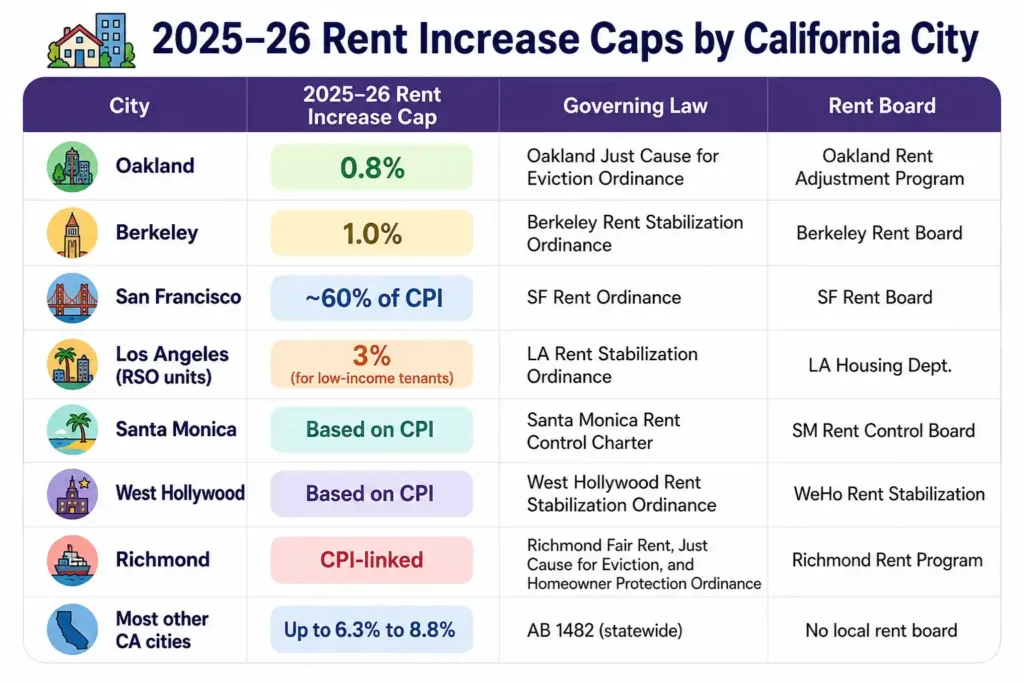
How to find your city’s rent board: Search your city name plus ‘rent board’ or ‘rent stabilization program.’ Most cities with rent control have an official website with current rates and complaint forms. If your city is not on this list, AB 1482’s statewide cap applies to you.
Rent Increase Notice Requirements in California 2026
A rent increase is not automatically legal just because the amount follows California limits. Landlords must also follow strict notice rules when delivering the increase. If they fail to give proper written notice or violate California notice requirements, the rent increase may not be lawful.
How Many Notices Are Required?
- 30 days’ written notice: Required for rent increases of 10% or less for tenants who have lived in the unit for under one year.
- 60 days’ written notice: Required in many local areas for tenants who have lived there for one year or more, for increases under 10%.
- 90 days’ written notice: Required in some cities or for increases above 10% on exempt properties.
What Must the Notice Include?
A legally valid California rent increase notice must clearly state:
- The tenant’s full name and unit address.
- The current rent amount.
- The new rent amount and the percentage increase.
- The effective date of the new rent.
- The method and date of delivery.
How Can the Notice Be Delivered?
- In-person delivery to the tenant.
- Mailing first-class with extra days added for delivery time.
- Posting on the door in some circumstances.
- Electronic delivery is only if the tenant previously agreed in writing.
Tip for Landlord: Always keep a copy of the signed notice or a certificate of mailing. If a tenant disputes the increase, you will need proof that you delivered it correctly and on time.
Also read: Metformin Lawsuit
New California Rent Laws 2026: AB 628, AB 414, and SB 610

Beyond the ongoing rent cap, California’s legislature passed three major new laws in 2025 that took effect in 2026. If you are a landlord or tenant in California right now, these matters affect you.
AB 628: Landlords Must Now Provide Working Stoves and Refrigerators
Starting January 1, 2026, AB 628 requires landlords to provide and maintain working stoves and refrigerators in most residential rental units. California now treats these appliances as part of the basic habitability standard for rental housing.
What landlords need to know:
- Recalled stoves or refrigerators must be replaced or repaired within 30 days of notice.
- Tenants can opt out and use their own appliances if they choose.
- Communal kitchens and certain subsidized housing units are excluded.
What tenants need to know: if your unit has a broken stove or refrigerator and your landlord refuses to fix it, you may have a legal claim based on unsafe living conditions. This could also affect eviction cases where a landlord tries to claim the unit is habitable.
AB 414: Modernizing California Security Deposit Rules
AB 414 updates how landlords and tenants handle security deposits. The law introduces three important changes:
- Landlords must return security deposits electronically if the tenant requests it.
- Both parties can mutually agree to apply the deposit toward last month’s rent.
- In multi-tenant leases, each tenant must receive a separate itemized deposit return.
This law is good for tenants who have had trouble getting their deposits back in a timely or transparent way. For landlords, it means updating your deposit return process before the end of any tenancy.
Related: Can a Landlord Keep My Security Deposit in California?
SB 610: Landlord Duties When Natural Disasters Strike
California’s history of wildfires, earthquakes, and floods made SB 610 a long-overdue protection. When a natural disaster affects a rental property, landlords must:
- Remove debris from rental units.
- Halt rent and all fees during mandatory evacuations.
- Return prepaid rent and security deposits if the unit becomes uninhabitable.
- Give tenants the right to return to their unit after repairs are complete.
- Allow tenants to terminate a lease on an uninhabitable unit without penalty.
- Notify tenants promptly when the unit is fit to live in again.
What About AB 1482’s Expiration Date?
AB 1482 is set to expire on January 1, 2030. California’s state officials have not yet passed legislation to extend or replace it. That means these California rent cap protections could end in less than four years unless state lawmakers extend the law.
For tenants, this is a reason to stay informed. For landlords, there is no reason to assume rent caps will disappear in 2030. Given California’s legislative history, an extension or replacement is likely before the sunset date.
Related: New California Rent Laws
For Tenants: What to Do If Your Landlord Raised Rent Illegally
This section is specifically for renters who believe their landlord violated the California rent increase limit of 2026. If you got a notice that seems too high, you do not have to just accept it.
Step 1: Calculate Whether the Increase Exceeds the Legal Cap
Start by confirming whether your unit is covered by AB 1482 or a local ordinance. Then find your regional CPI rate from the California Apartment Association or the Bureau of Labor Statistics.
Use the formula: 5% + your CPI = your cap.
Step 2: Send a Written Dispute Letter
Write your landlord a clear, professional letter stating:
- The current rent and the proposed increase.
- Your calculation of the legal maximum.
- The specific law they violated (AB 1482 or your city’s ordinance).
- A request to correct the increase in the legal amount.
Keep a copy of the letter. Send it by email and certified mail so you have a paper trail.
Step 3: File a Complaint With Your Local Rent Board
If you live in a city with a rent board, file a formal complaint. Most rent boards offer free forms online. In cities like Oakland, Berkeley, San Francisco, and Los Angeles, rent boards have real enforcement power and can order landlords to refund unlawful increases.
Step 4: Contact a Tenant Rights Attorney or Legal Aid
If your landlord ignores your letter or retaliates, contact a tenant rights attorney.
Free help is available from:
- LawHelpCA at lawhelp.org/ca.
- Legal Aid Society of San Diego at lassd.org.
- Your county’s local legal aid office.
Your Just Cause Eviction Protections
If you have lived in your unit for more than 12 months, AB 1482 provides you with cause eviction protection. Your landlord cannot remove you simply because you disputed an illegal rent increase. Retaliation is itself illegal under California law.
Just cause eviction means your landlord can only remove you for specific reasons listed in the statute, such as nonpayment of rent, substantial lease violations, or owner move-in under very strict conditions.
Related: Contingency Lawyer Meaning
For Landlords: How to Raise Rent Legally in California in 2026
Raising rent the wrong way in California is expensive. Tenants can dispute unlawful increases, file complaints with rent boards, and even sue. The good news is that staying compliant is not complicated if you follow a clear checklist.
The California Landlord Rent Increase Compliance Checklist
- Confirm AB 1482 coverage: Is your building 15+ years old? If yes, the rent cap almost certainly applies.
- Check for local rent control: Does your city have its own ordinance that supersedes AB 1482? If yes, use the city’s rate, not the statewide cap.
- Find your regional CPI: Look up the April 2025 CPI for your metro area from the CAA or BLS.
- Calculate your maximum increase: 5% + CPI, capped at 10%.
- Draft a compliant notice: That includes all required details and deliver it properly.
- Time the notice correctly: For a rent increase starting on August 1, landlords must usually give notice by July 1 for a 30-day notice or by June 1 if a 60-day notice is required.
- Document everything: Keep copies of all notices, calculations, and delivery confirmations.
- Audit new 2026 laws: Check that all units have working stoves and refrigerators under AB 628 and update your deposit return process under AB 414.
Penalty for Unlawful Rent Increases
California does not take unlawful rent increases lightly. If you charge more than the legal cap allows, a tenant can:
- Withhold the excess portion of rent
- File a complaint with the local rent board
- Sue for the overpaid amount plus interest
- Seek attorney fees if they win in court
Some cities also impose civil penalties on landlords who repeatedly violate rent control rules. It is simply not worth the risk.
Related: Can a Landlord Enter Without Notice in California?
Frequently Asked Questions About California Rent Increases in 2026
Can a landlord raise rent in the middle of a lease in California?
No. A landlord cannot change the rent during a fixed-term lease unless the lease itself specifically allows it. The California rent increase law only applies at renewal or when a tenant is on a month-to-month agreement.
Can a landlord raise rent after a new tenant moves in?
Yes, when a new tenant moves into a previously covered unit, the landlord can set the rent at any market rate. AB 1482 does not cap what landlords can charge at the start of a new tenancy. The cap only applies to increases during an existing tenancy.
Can my landlord raise my rent more than once a year?
AB 1482 allows up to two rent increases per 12-month period, but the combined total cannot exceed the annual cap. So if the cap is 8.2% and your landlord already gave you a 4% increase six months ago, the second increase cannot exceed 4.2%.
What is the difference between rent control and AB 1482?
People often use the term “rent control” for any limit on rent increases, but California actually has two different systems. AB 1482 is the statewide rent cap law that applies across much of California, while some cities have their own local rent control laws. If both rules apply to your rental unit, the stricter rule usually controls the rent increase.
Final Thoughts: Know Your Rights, Know Your Numbers
California’s rental laws are some of the most detailed in the country, and for good reason. Housing costs have been a crisis for years, and millions of renters depend on these protections to stay in their homes.
Whether you are a tenant who just received a suspicious rent increase notice or a landlord trying to run a compliant business, the rules are clear. The AB 1482 rent increase limit for 2026 is 5% + your local CPI, capped at 10%. Local ordinances in cities like Oakland, Berkeley, and San Francisco are even lower. New 2026 laws on appliances, security deposits, and disaster duties add more layers that every landlord must understand.
Do not guess. Use the formula. Check your city’s rent board. Give proper written notice. And if something does not look right, reach out to a tenant rights organization or legal aid.
Your home is worth protecting. The law is on your side.
Also read: Can a Narcissist Win Custody in California?
Sources & References
- https://caanet.org/caa-updates-cpi-calculator-for-rent-increases-under-ab-1482-2026/
- https://leginfo.legislature.ca.gov/faces/codes_displaySection.xhtml?lawCode=CIV§ionNum=1946.2
- https://rentlatefee.com
- https://www.lassd.org/resource/rent-increases
- https://leginfo.legislature.ca.gov/faces/codes_displaySection.xhtml?sectionNum=827.&lawCode=CIV
- https://leginfo.legislature.ca.gov/faces/billTextClient.xhtml?bill_id=201920200AB1482
- https://dir.ca.gov
- https://www.doorloop.com
Disclaimer: This content is for general informational purposes only and does not create an attorney-client relationship or legal advice.