California Mold Laws for Renters: Tenant Rights, Landlord Duties, and Legal Options
Finding mold in your rental apartment is one of the most unsettling experiences as a tenant. It often starts with something small. You notice a dark stain spreading across the bathroom ceiling or catch a damp, musty smell every time you open the bedroom closet.
After a few weeks, you wake up with headaches, coughing, or a tight feeling in your chest, and your doctor asks whether anything has changed in your living environment.
You are not helpless. California mold laws for renters are among the strongest tenant protections in the entire country. The state has passed law after law, year after year, to make sure landlords cannot ignore a mold problem and get away with it.
This article explains what California law says about mold, when your landlord is legally required to fix it, and what steps you can take if you are living with black mold in a California apartment or your landlord keeps ignoring your complaints.
Your Rights Under California Mold Laws for Rental Units
California mold laws for renters rest on a solid legal foundation built across multiple statutes. Understanding these laws is the first step toward knowing exactly where you stand.
Every rental unit in California comes with an implied warranty of habitability. This is not a clause your landlord chooses to include in the lease. It automatically exists under California Civil Code §1941.1, which requires landlords to provide and maintain a home that is safe and fit for human occupation.
Under this law, your unit must have working plumbing, proper weatherproofing, adequate ventilation, and effective waterproofing. When any of those conditions fail, and moisture gets in, mold follows. The law treats that chain reaction as the landlord’s responsibility to fix.
Health and Safety Code §17920.3: When Mold Makes a Rental Property Substandard
California Health and Safety Code §17920.3 specifically defines visible mold growth as a condition that makes a home substandard and uninhabitable. The moment mold appears on walls, ceilings, or floors and poses a health threat, your unit legally fails the habitability standard.
The Toxic Mold Protection Act of 2001
California passed the Toxic Mold Protection Act of 2001 (Health and Safety Code Sections 26100 to 26156) to create a statewide framework for mold disclosure, assessment, and remediation. This law requires landlords to disclose any known mold problems to tenants before lease signing. If your landlord knew about mold and said nothing when you moved in, that is a direct violation of this act.
Senate Bill 655: Mold Officially Becomes a Habitability Violation
For years, mold claims in California often created confusion because state law did not specifically identify visible mold growth as a substandard housing condition. Senate Bill 655, signed into law on October 9, 2015, and effective January 1, 2016, changed that.
It specifically added visible mold growth to the list of conditions that can make a rental unit legally uninhabitable under California law. Before SB 655, landlords sometimes argued that mold by itself did not trigger habitability obligations, especially if no other serious housing defects were present.
SB 567 (2024): New Tenant Protections You Need to Know
Senate Bill 567, which took effect on April 1, 2024, updated the California Tenant Protection Act and expanded the definition of substantial remodeling to include the abatement of hazardous materials, including mold, in certain situations. What does that mean for you?
If your landlord tries to evict you under the excuse of doing mold remediation, SB 567 gives you the right to move back into your unit at the same rental rate once the work is complete. If the landlord fails to start or complete the work, they must offer you the opportunity to re-rent the unit and reimburse you for your reasonable moving expenses.
SB 610 (2025): Mold After Natural Disasters
California passed Senate Bill 610 in 2025, creating new landlord responsibilities for disaster recovery. Under the law, if a wildfire, flood, or other disaster causes mold, water damage, smoke residue, or similar hazards in your rental unit, your landlord must take reasonable steps to remediate those conditions before the home is considered safe to reoccupy.
You do not owe rent during a mandatory evacuation period, and you have the right to return at your original rental rate once remediation is complete.
How Long Does a Landlord Have to Fix Mold in California?
Under California Civil Code §1942, once you give your landlord written notice about a habitability problem, including mold, they have a reasonable time to make repairs. In practice, courts have treated 30 days as the standard benchmark for what counts as reasonable.
However, if the mold problem creates an urgent health risk, particularly for children, elderly residents, or anyone with asthma or a compromised immune system, a shorter response time may be required.
Mold Disclosure Before You Sign the Lease
Under Health and Safety Code §26147, a landlord who knows, or reasonably should know, that dangerous mold is present must provide written notice. If they fail to do so and mold turns out to be present, they have violated the disclosure requirement.
Since 2022, landlords have been required to provide the state’s “Information on Dampness and Mold for Renters in California” booklet to prospective tenants before the rental agreement is finalized.
Maria, a cousin of mine, rented in San Diego and moved into a two-bedroom apartment in 2023. The landlord said nothing about moisture problems. Within three months, she noticed black spots spreading across her bedroom wall, and her young daughter started coughing constantly.
When she pulled her lease paperwork, there was no mold disclosure form. That omission alone gave her grounds for legal action before the landlord failed to fix anything, even if it came into play.
Landlord Duties Once You Report Mold
Once you notify your landlord of a mold problem in your California rental, they are generally expected to:
- Inspect the unit within a reasonable timeframe.
- Hire a qualified mold remediation professional if the growth is substantial.
- Repair the underlying moisture source (leaking pipes, faulty roof, poor ventilation) before or alongside mold removal.
- Notify you of the timeline and remediation plan.
- Provide you with copies of any testing or inspection reports upon request (SB 610).
A landlord who patches over the mold without fixing the source is not in compliance. Mold will return, and the law holds them responsible for that failure. Read our detailed guide on how to handle a bad landlord.
Can a Tenant Withhold Rent for Mold in California?
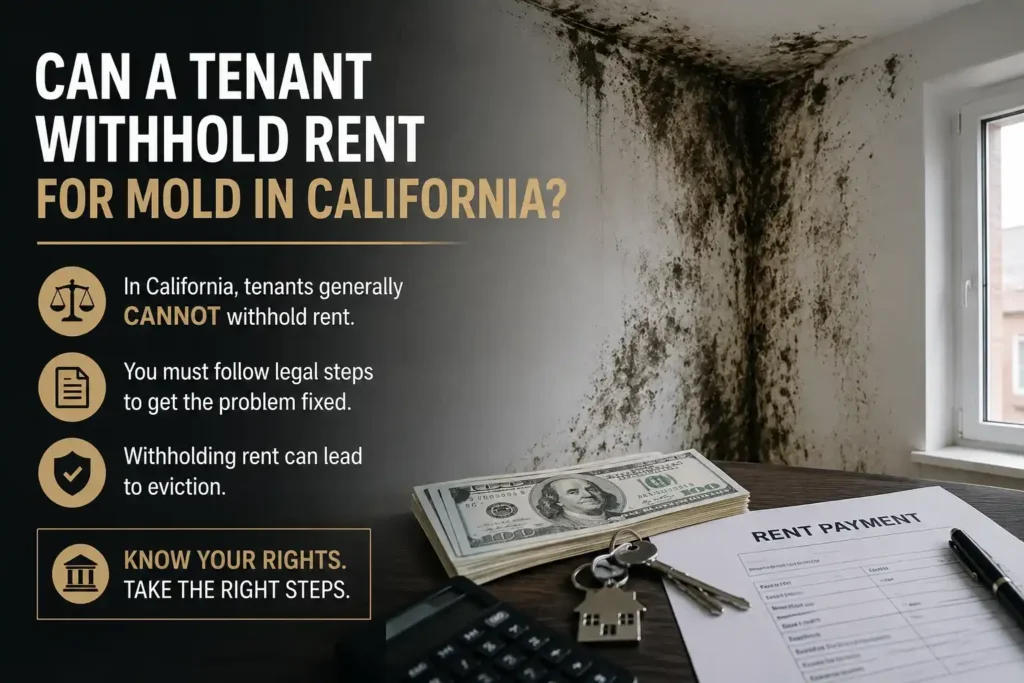
Yes, under certain conditions. California law allows rent withholding when a rental unit has visible mold. However, you must follow a specific process to protect yourself legally:
- Notify your landlord in writing about the mold problem.
- Give them a reasonable time (typically 30 days) to respond.
- Document that they have failed to act.
- Consult a tenant rights attorney before withholding rent.
Withholding rent without following these steps can expose you to eviction proceedings, even if your landlord is in the wrong. The documentation and written notice are what protect you.
Can a Tenant Break a Lease Due to Mold in California?
This is the question I hear most often, and the answer is yes, in many situations. When mold makes your unit not safe to live in, you may be able to claim what is called constructive eviction and terminate your lease without penalty. To do this successfully, you generally need to show:
- The mold was serious enough to make the unit unfit for use.
- You gave your landlord written notice and a reasonable opportunity to fix it.
- Your landlord failed to act within a reasonable time.
- You vacated the unit because of the mold, not for an unrelated reason.
Do not simply walk out and stop paying rent. Consult a California tenant rights attorney first to walk through the facts of your specific situation.
The Repair and Deduct Remedy
Under California Civil Code §1942, if your landlord fails to make necessary repairs within a reasonable time after written notice, you have the right to hire someone to fix the problem yourself and deduct the cost from your rent. This remedy comes with limits: you can use it only once in any 12 months, and the deduction cannot exceed one month’s rent.
This remedy works best for moderate mold problems tied to a specific fixable issue, such as a leaking pipe under a sink. For extensive black mold in a California apartment, legal action is usually the more appropriate route.
Also read: How to Fight an Eviction Notice
How a Tenant Can Sue the Landlord for Mold in California
When a landlord ignores a serious mold problem after written notice, you have two main legal paths:
- Small claims court: You can sue for up to $12,500 for costs, including damaged property, medical bills, and temporary housing. This option is quicker and costs less, but the amount of compensation you can receive is limited.
- Civil court: For larger damages, including significant personal injury claims from mold exposure, a civil lawsuit may be necessary. California’s statute of limitations for property damage from mold is 3 years from when the damage occurred or was discovered. For personal injury claims, including health problems caused by mold exposure, the deadline is two years.
A California tenant rights attorney can evaluate your case and tell you which route fits your situation. Many tenant lawyers work on a contingency basis, meaning you pay nothing up front.
Anti-Retaliation Protection: Civil Code §1942.5
This is one of the most important and least-talked-about sections of California apartment mold law. Under Civil Code §1942.5, it is illegal for your landlord to retaliate against you for reporting a habitability problem. Retaliation includes:
- Raising your rent.
- Threatening eviction.
- Reducing services (like not responding to maintenance requests).
- Harassing you in any way.
If your landlord takes any of these actions within 180 days of your written mold complaint, California law presumes the action is retaliation. The burden shifts to the landlord to prove otherwise.
Found Mold in Your Rental? Take These Steps Right Away
Knowing California‘s mold laws is one thing. Having a clear action plan is another. Here is exactly what to do, in order.
Step 1: Document Everything (Day 1)
- Take clear, date-stamped photos and videos of every area affected by mold.
- Document any nearby water stains, peeling paint, leaks, or musty odors.
- Write down the date you first noticed the mold problem.
- Keep a record of any symptoms you or your family members experience that may be related to the mold.
- Save all evidence in one place in case you need to prove the problem later.
- If you have any prior written communications with your landlord about leaks or moisture problems, save every single one.
Step 2: Send Written Notice to Your Landlord (Day 1 to Day 3)
This is the step that most renters skip, and it is the most critical one. Verbal complaints give you nothing. Send your landlord a written notice by certified mail with return receipt requested, or at a minimum by email, so you have a timestamp.
Your notice should state:
- The specific location of the mold in your unit.
- The date you first discovered it.
- Any health symptoms you or household members have experienced.
- A clear request for inspection and remediation.
- A stated deadline (30 days is the standard reasonable timeframe).
See the template in the next section.
Step 3: Contact Code Enforcement (Day 7 to Day 14)
If your landlord does not respond within a reasonable time, file a complaint with your local housing or building department. Code enforcement can inspect your unit, document the violation, and issue a notice of violation to your landlord. This creates an official government record of the problem, which strengthens any future legal claim.
Step 4: Know the 30-Day Deadline
In many cases, courts view 30 days as a reasonable amount of time for a landlord to address and fix a mold problem.
If your landlord passes 30 days without making meaningful progress, you are in a stronger legal standing to pursue rent withholding, repair and deduct, lease termination, or a lawsuit.
Step 5: Consult a Tenant Rights Attorney
If your landlord has ignored your written notice and you are past the 30-day mark, talking to a California tenant rights attorney is the smartest next move. Many offer free case evaluations. They can tell you whether your situation supports a lawsuit, a small claims filing, or another remedy.
How to Write a Mold Complaint Letter to Your Landlord in California (Template)
Here is a template you can adapt right now.
[Your Name] [Your Address, Unit Number] [City, State, ZIP] [Date]
[Landlord’s Name] [Landlord’s Address]
Re: Written Notice of Mold and Request for Immediate Remediation
Dear [Landlord’s Name],
I am writing to formally notify you of a mold problem in my rental unit at [Address]. I first noticed visible mold growth on [Date] in the following areas: [describe specific locations, e.g., “the bathroom ceiling, the wall behind the bedroom closet, and under the kitchen sink”].
Several household members have experienced the following health symptoms since the mold appeared: [describe symptoms, e.g., “persistent cough, nasal congestion, and headaches”].
Under California Civil Code §1941.1, Health and Safety Code §17920.3, and Senate Bill 655, you are legally required to maintain a habitable living environment. Visible mold constitutes a substandard housing condition under California law.
I am requesting that you inspect the affected areas and begin remediation within 30 days of the date of this letter. Please confirm receipt of this notice in writing.
If I do not receive a response or see meaningful action by [Date 30 days from today], I will exercise my legal remedies as a tenant under California law, including but not limited to contacting code enforcement, withholding rent, or pursuing legal action.
Sincerely, [Your Name] [Phone Number] [Email Address]
How Long Does a Mold Lawsuit Take in California?
This is one of the most searched questions about California mold laws, and the honest answer is: it depends on the complexity of your case.
Several factors are listed below:
- Small claims court cases typically resolve in 30 to 90 days from filing. The process is streamlined, and you do not need an attorney.
- Civil lawsuits in California Superior Court take considerably longer. Most straightforward tenant mold cases settle or reach a verdict within 12 to 24 months. Complex cases involving significant personal injury or multiple plaintiffs can take three years or longer.
- Mediation or settlement negotiations can significantly shorten the timeline. Many landlords settle before a case reaches trial, particularly when the tenant has strong documentation.
For property damage related to black mold in California, you have three years from the date the damage occurred or was reasonably discovered.
I always recommend filing sooner rather than later. Evidence degrades, witnesses forget details, and the mold itself gets remediated, which removes physical evidence.
Can Mold Affect Your Security Deposit in California?
Under California Civil Code §1950.5, a landlord can only deduct from your security deposit for damage caused by the tenant beyond normal wear and tear. Mold that results from the landlord’s failure to maintain the property is not the tenant’s fault.
However, there is a situation where things get tricky. If you noticed mold and failed to report it for an extended period, and the delay made the problem worse, a landlord might argue that your failure to report contributed to the damage. This is exactly why prompt written notice is so important. When you document and report mold quickly, you protect not just your health but your security deposit, too.
If your landlord deducts mold cleanup costs from your security deposit, but the mold was due to a structural issue or poor maintenance, you can challenge that deduction.
Health Effects of Mold Exposure: When to See a Doctor
Mold exposure can trigger a wide range of health problems depending on the type of mold, the level of exposure, and your individual health status. Common symptoms of toxic mold exposure include:
- Chronic coughing and sneezing.
- Nasal congestion and a runny nose.
- Eye irritation and watering.
- Skin rashes.
- Headaches and fatigue.
- Worsening of asthma or allergy symptoms.
Black mold (Stachybotrys chartarum) can produce mycotoxins that have been linked to more serious health effects with long-term exposure. Children, older adults, pregnant women, and people with asthma or weak immune systems are more at risk.
See a doctor immediately if you or anyone in your household experiences persistent respiratory symptoms. Bring photos of the mold to your appointment and share them with your doctor.
According to the California Department of Public Health (CDPH), visible mold, mold odor, or water damage is considered a health concern, even without lab testing. You don’t need test results to take action.
Does Renters Insurance Cover Mold in California?
Standard renters’ insurance policies in California generally do not cover mold remediation as a standalone event. However, if the mold resulted from a covered peril under your policy (such as a burst pipe or accidental water discharge), your policy may cover the cost of removing mold from your personal belongings and paying for temporary housing while repairs are completed.
Before you file a claim, review your policy carefully for:
- Mold exclusions: Many standard policies exclude mold damage entirely.
- Water damage coverage: If the mold traces back to a covered water event, you may have a path to a claim.
- Additional living expenses (ALE) coverage: If mold makes your unit uninhabitable, ALE coverage can pay for a hotel or temporary rental while you are displaced.
Contact your insurance company as soon as you find mold and document the source of moisture. If landlord negligence caused it, your insurer may seek repayment from the landlord through insurance recovery.
Reporting Mold by City in California
California apartment mold laws give you the right to report habitability violations to local authorities. Here is where to go in the major California cities.
Los Angeles
Contact the Los Angeles Housing Department (LAHD) to report mold and habitability violations. You can file a complaint online through the LAHD Housing Code Complaint portal or call the Housing Hotline at (866) 557-7368. LA County residents outside the city limits can contact the LA County Department of Public Health’s Environmental Health Division.
San Francisco
File a complaint with the San Francisco Department of Building Inspection (DBI) through their online complaint portal or by calling (628) 652-3400. The DBI handles habitability violations, including mold, for rental properties throughout San Francisco.
San Diego
Contact the City of San Diego Development Services Department to file a housing code complaint. For health-related mold concerns, the County of San Diego Department of Environmental Health and Quality handles complaints involving potential health hazards.
Sacramento
Report mold and habitability problems to the City of Sacramento Community Development Department’s Code Enforcement Division. Sacramento County residents can also contact the County Environmental Management Department for mold-related health complaints.
Oakland
Oakland tenants can report habitability violations, including mold, to the City of Oakland’s Code Enforcement Bureau. The Oakland Rent Adjustment Program also handles complaints tied to substandard conditions in rent-controlled units.
Bottom Line
Living with mold in a California rental is not something you have to accept. State law gives tenants the right to demand repairs, report violations, and, in serious cases, take legal action. Start by giving written notice, documenting the problem, and contacting code enforcement if needed. If the landlord still refuses to act, you may need legal help. Safe housing is a legal right in California, not an option.
Related: Is the landlord allowed to enter without notice in California
References
- California Department of Public Health (CDPH)
- California Legislative Information Civil Code §1941.1
- California Legislative Information Civil Code §1942
- California Legislative Information Civil Code §1942.5 (Anti-Retaliation)
- California Legislative Information Health and Safety Code §17920.3
- California Legislative Information Health and Safety Code §26147 (Mold Disclosure)
- Senate Bill 655 (2015) Mold as habitability violation
- Senate Bill 567 (2023, effective April 2024) Tenant Protection Act amendments
- Senate Bill 610 (2025) Natural disaster remediation duties
Disclaimer: This article is for informational purposes only and does not constitute legal advice. If you are facing a mold dispute with your landlord, consult a licensed California tenant rights attorney for guidance specific to your situation.