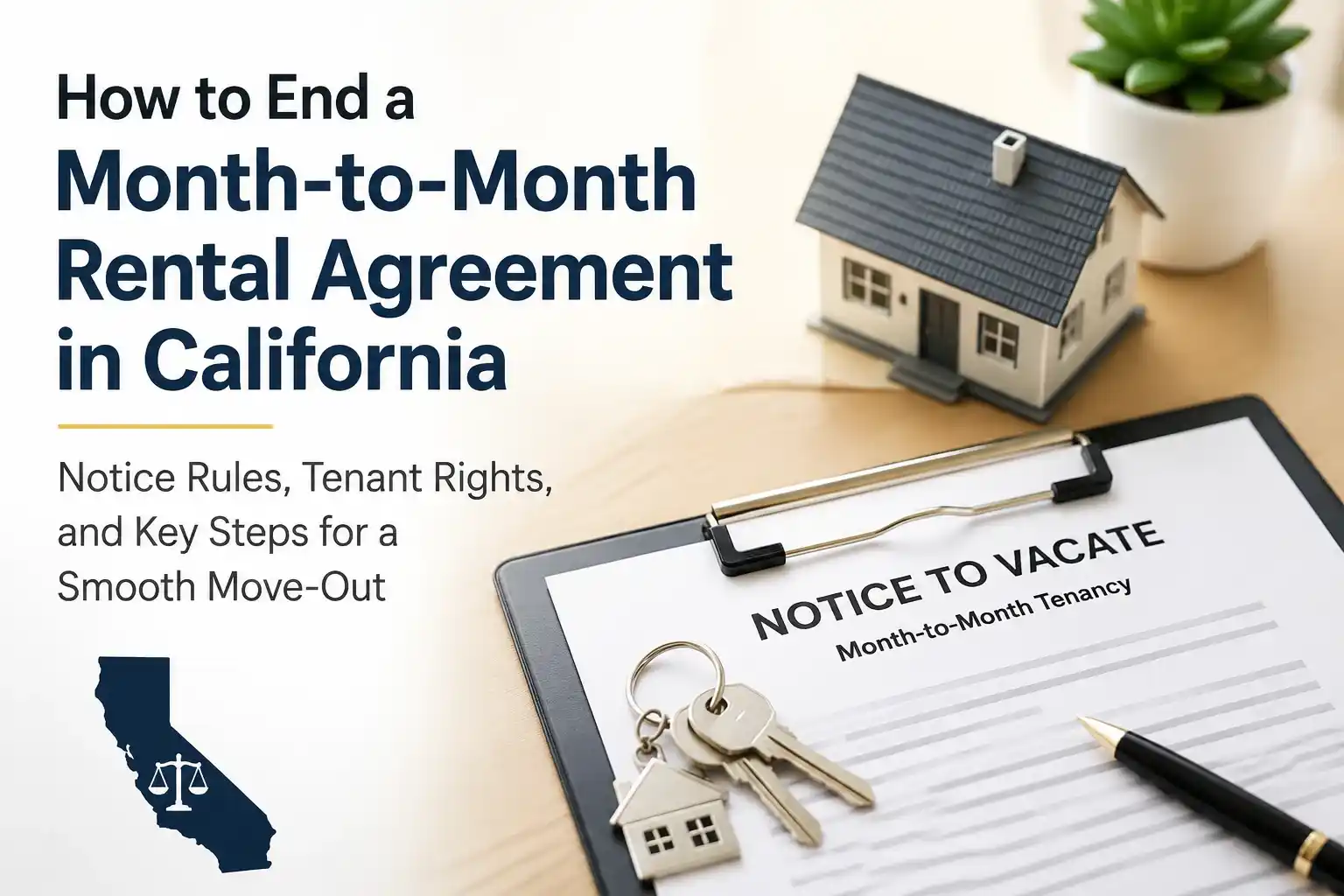
How to End a Month-to-Month Rental Agreement in California (Guide for Tenants & Landlords)
Quick Answer: In California, a tenant on a month-to-month lease must give at least 30 days’ written notice to end the tenancy, no matter how long they’ve lived there. A landlord must give 30 days’ notice if the tenant has lived in the unit less than one year, or 60 days’ notice if the tenant has lived there one year or more.
If the unit is covered by the Tenant Protection Act (AB 1482), the landlord also needs a legally valid “just cause” reason once the tenant has lived there 12 months or more, regardless of the notice period.
Many landlords and tenants assume they can end a month-to-month tenancy in California instantly. The Tenant Protection Act and local rent ordinances can add notice periods, just-cause limits, or relocation obligations in certain situations.
That mismatch between expectation and legal structure creates confusion and disputes. This guide about How to End a Month-to-Month Rental Agreement in California breaks down the difference between a tenant’s notice to vacate and a landlord’s termination process. It also explains the legal steps required if an occupant does not leave on time, and when an unlawful detainer case may come into play.
Understanding Month-to-Month Tenancy in California
A month-to-month tenancy (sometimes called a periodic tenancy) is a rental arrangement with no fixed end date. Rent is paid monthly, and either side can end the arrangement by giving proper notice.
You may be on a month-to-month tenancy even if you never signed paperwork stating so. Under California law, if a fixed-term lease expires and the landlord continues to accept rent without a new signed lease, the agreement can automatically convert to a month-to-month occupancy.
No new paperwork is required for this conversion. This matters because many tenants and landlords do not realize they have switched from a fixed-term lease to a periodic one, and they apply the wrong notice rules as a result.
How Much Notice Does a Tenant Need to Give?
Under Civil Code Section 1946 and Section 1946.1, a tenant ending a month-to-month tenancy must give the landlord at least 30 days’ written notice, regardless of how long they have lived in the unit. There is no 60-day requirement for tenants, even after years in the same rental.
A few practical points:
- Leaving early doesn’t stop rent charges; rent is due until the notice period ends.
- The 30-day countdown starts when the notice is delivered, not when it is written.
- Some leases may allow a shorter notice (like 7 days) if both sides agreed in writing at the start, but most standard leases don’t include this.
- A lease cannot legally force a tenant to give more than 30 days’ notice. Any such clause is not valid.
Tip: Giving notice close to your rent due date helps you avoid extra charges for unused time.
How Much Notice Does a Landlord Need to Give? (30 vs. 60-Day Comparison)
California sets clear notice rules, but the exact timeline depends on how long the tenant has lived in the unit. Understanding the difference between 30-day and 60-day notices is key before taking any steps to end a tenancy.
Landlords face a more nuanced rule, set out in Civil Code Section 1946.1.
| Situation | Required Notice |
|---|---|
| Tenant has occupied the unit for less than 1 year. | 30 days written notice |
| Tenant has occupied the unit for 1 year or more. | 60 days written notice |
| Property is being sold and meets California legal exceptions where the buyer intends to occupy the unit and all statutory requirements are satisfied. | 30 days written notice, even if the tenant has lived there over one year |
Is Your Rental Covered by the Tenant Protection Act (AB 1482)? Exemption Checklist
Not every rental in California is covered by statewide rent control rules, so coverage can make a big difference in how a tenancy ends. The Tenant Protection Act (AB 1482) applies only to specific types of properties and tenants relying on legal exemptions. Before moving forward, it’s important to understand whether your rental is actually covered or exempt.
Properties generally exempt from AB 1482’s just-cause requirement include:
- Housing built within the last 15 years (on a rolling basis).
- Single-family homes and condos, but only if both of the following are true:
- The property is not owned by a corporation, a real estate investment trust (REIT), or an LLC with at least one corporate member.
- The landlord gave the tenant written notice of the exemption using the required language under California Civil Code Sections 1946.2 and 1947.12.
- If the owner lives in the home and rents out no more than two bedrooms or units, the property is generally exempt.
- Situations where the tenant shares a bathroom or kitchen with an owner who lives there as their primary residence.
- Duplexes where the owner occupied one unit as their primary residence from the start of the tenancy and continues to do so.
- Properties already covered by a local rent control or just-cause ordinance that is stricter than state law (common in cities like Los Angeles, San Francisco, and Oakland).
- Dormitories and certain deed-restricted affordable housing.
Landlords assume their single-family home is automatically exempt because it is a single-family home. It is not. Without the written exemption notice in the lease or a signed addendum, the property is not exempt, even if it would otherwise qualify.
If you are unsure whether your lease includes this language, check it directly or consult an attorney before sending a termination notice.
How to Deliver a Valid Notice (Methods That Hold Up Legally)
A notice that is correctly written but improperly delivered can be challenged in court. California law, referencing Code of Civil Procedure Section 1162, recognizes these delivery methods:
- Personal delivery to the tenant or landlord.
- Substituted service, leaving the notice with a person of suitable age at the home or workplace, then mailing a copy.
- Posting and mailing, if personal delivery and substituted service are not reasonably possible.
- Certified or registered mail, which creates a paper trail proving when notice was sent.
Text messages and informal emails generally do not qualify as proper service of a termination notice. Landlords should first deliver the formal written notice through an approved method and use email only as a courtesy copy.
If the last day of a notice period falls on a Saturday, Sunday, or legal holiday, it can affect how the deadline is handled in California. To stay safe, it’s a good idea to add an extra day or two when setting your move-out date. This helps avoid any disputes about missing the deadline.
Sample 30-Day Notice Letter (Tenant Version)
Here is a clean template you can adapt. Replace the bracketed sections with your own information.
[Your Name]
[Rental Property Address]
[City, State, ZIP]
[Date]

[Landlord's Name]
[Landlord's Address]

RE: 30-Day Notice to Terminate Month-to-Month Tenancy

Dear [Landlord's Name],

This letter serves as my written 30-day notice of intent to terminate
my month-to-month tenancy at [Rental Property Address], in accordance
with California Civil Code Section 1946.

My last day of occupancy will be [Move-Out Date, at least 30 days
from the date of this notice].

Please send my security deposit refund and itemized statement to the
following forwarding address:

[Forwarding Address]

I will leave the unit in clean condition and return all keys by the
move-out date listed above.

Sincerely,
[Your Signature]
[Your Printed Name]
Sample Notice Letter (Landlord Version)
[Your Name / Property Management Company]
[Property Address]
[City, State, ZIP]
[Date]

[Tenant's Name]
[Rental Unit Address]

RE: [30-Day / 60-Day] Notice to Terminate Month-to-Month Tenancy

Dear [Tenant's Name],

This letter serves as written notice that your month-to-month tenancy
at [Rental Property Address] will terminate on [Termination Date],
which is at least [30/60] days from the date of this notice, in
accordance with California Civil Code Section 1946.1.

[If the property is subject to the Tenant Protection Act and the
tenant has lived there 12 months or more, include the specific
just-cause reason here, as required under Civil Code Section 1946.2.]

You are required to vacate the premises and return all keys by the
termination date listed above. Your security deposit will be returned
within 21 days of move-out, along with an itemized statement of any
deductions, as required under Civil Code Section 1950.5.

State law permits former tenants to reclaim abandoned personal
property left at the former address, subject to certain conditions.

Sincerely,
[Signature]
[Printed Name]
Special Situations That Affect Ending a Tenancy in California
Under Civil Code Section 1946.7, a tenant (or a household member) who is a victim of domestic violence, sexual assault, stalking, human trafficking, or elder/dependent adult abuse can end their lease early with just 14 days’ written notice, without penalty.
The tenant must attach one of several acceptable forms of documentation, such as a restraining order, a police report, or a statement from a qualified counselor or medical professional. Rent is owed only for the 14 days, and the landlord cannot require the tenant to forfeit their security deposit because of the early termination. This protection applies only to the survivor named on the notice; any co-tenants remain bound by the original lease.
Military Deployment
Servicemembers protected under the Servicemembers Civil Relief Act (SCRA) can end a lease early in certain situations, like a permanent change of station or deployment of 90 days or more. This is a federal protection that applies along with California’s state notice rules, not instead of them.
Tenant Death
If a sole tenant on a month-to-month lease passes away, the tenancy generally does not automatically terminate. The estate or remaining occupants typically need to give notice or work with the landlord to end the tenancy. Local practices can vary, so consulting an attorney or a local tenant resource is a good idea in this situation.
What Happens If the Tenant Doesn’t Move Out?
If a tenant stays past the termination date in the notice, they become a holdover tenant, and the landlord may begin the unlawful detainer process, California’s formal legal term for an eviction lawsuit. Key points:
- The landlord cannot physically remove a tenant or change the locks without a court order. Self-help eviction is illegal in California.
- The landlord must file an unlawful detainer lawsuit with the court after the notice period expires.
- The tenant has a limited window to respond to the court summons.
- If the landlord wins, the court issues a writ of possession, and only the sheriff can carry out the physical removal.
This process typically takes weeks, not days, so neither side should expect an immediate resolution.
When Do You Get Your Security Deposit Back After Moving Out?
Under Civil Code Section 1950.5, a landlord has 21 calendar days after a tenant moves out to either:
- Return the full security deposit, or
- Provide an itemized statement explaining any deductions, along with receipts for repairs or cleaning costs over $125.
Common lawful deductions include unpaid rent, damage beyond normal wear and tear, and cleaning needed to return the unit to its move-in condition. Normal wear and tear, such as minor carpet fading or small nail holes, cannot be deducted.
Tip for tenants: Take dated photos of the unit on your way out, and provide your forwarding address in writing so the 21-day clock has a clear delivery point.
Month-to-Month Lease vs Fixed Lease: Which Is Better in California?
Choosing between a month-to-month lease and a fixed-term lease in California depends on your lifestyle and financial priorities. Understanding how both work can help you decide which rental arrangement fits your needs.
This comparison helps you quickly understand the key differences:
| Feature | Month-to-Month Lease | Fixed-Term Lease |
|---|---|---|
| Flexibility | High flexibility, can end with short notice | Low flexibility, locked for lease term |
| Stability | Less stable, rent and terms can change with notice | More stable, rent and terms stay fixed |
| Notice Requirement | Usually 30 days written notice | No early notice unless breaking lease |
| Best For | Short-term or flexible living needs | Long-term housing stability |
| Rent Changes | Can change with proper legal notice | Fixed for lease duration |
City-Specific Rules for Ending a Tenancy in California
Several California cities have local ordinances that are stricter than state law, and the stricter rule controls. If you are in one of these cities, check local rules before sending or responding to a notice:
- Los Angeles: The Rent Stabilization Ordinance and Just Cause Ordinance impose additional protections beyond AB 1482 for many units.
- Oakland: The Tenant Move Out Agreement Ordinance and local just-cause rules add requirements on top of state law.
- San Francisco: The San Francisco Rent Ordinance has its own just-cause eviction protections, generally considered more protective than state law.
- San Jose: Local rent stabilization rules apply to many older multi-unit buildings.
- San Diego: The city’s Tenant’s Right to Know ordinance and related rules add disclosure requirements.
Frequently Asked Questions
Can rent be increased during a month-to-month tenancy in California?
Yes, rent can be increased in this type of rental agreement, but California rent increase rules must be followed. Landlords must give proper written notice, usually 30 or 90 days, depending on the increase amount. Units covered by AB 1482 also have annual rent caps. Local rent control laws may impose even stricter limits.
What happens if I move out of a month-to-month rental in California without giving notice?
If you move out of a rental in California without giving notice, you can still be responsible for rent until the proper notice period ends. Most tenants are required to give at least 30 days’ written notice, so leaving early can create a financial obligation for that time. The landlord may also deduct unpaid rent or other costs from the security deposit.
Can my landlord in California force me to stay after I give 30 days’ notice?
No, your landlord cannot force you to stay after you give a valid 30-day notice in a month-to-month tenancy in California. Once the notice is properly delivered, the tenancy is set to end on the date you stated.
Bottom line
The right choice depends on how much flexibility or stability you need, since rental agreements in California each come with different notice rules and obligations. Understanding your lease terms clearly helps you avoid surprises when it’s time to move or make changes.
This article is for general informational purposes and does not constitute legal advice. Notice requirements can vary based on local ordinances, lease terms, and individual circumstances. Consult a qualified California landlord-tenant attorney for guidance on your specific situation.
References
- California Civil Code Section 1946
- California Civil Code Section 1946.1
- California Civil Code Section 1946.2 (Tenant Protection Act of 2019 / AB 1482)
- California Civil Code Section 1946.7 (Early Termination for Survivors)
- California Civil Code Section 1950.5 (Security Deposits)
- AB 1482: The California Tenant Protection Act of 2019, Berkeley Rent Board
- California Department of Real Estate, Reference Book
- Judicial Council of California, Unlawful Detainer Forms and Process
- California Courts, Domestic Violence Resources