
Tenants’ Rights in California When the Landlord Sells The House (2026 Guide)
Getting the news that the house you call home is being sold can feel like a punch to the gut. Your mind starts racing. Will you have to move? How much notice will you get? What happens to your lease, your security deposit, and the place you currently call home? For many California renters, the uncertainty is often more frightening than the sale itself.
What surprises many renters is that tenants’ rights in California when the landlord sells house are often much stronger than they expect. A property sale does not automatically cancel your lease or allow a new owner to remove you without following the law. Whether you rent month-to-month or have a fixed-term lease, California provides important protections that can help you stay informed and avoid costly mistakes.
This 2026 guide explains exactly what happens when a landlord sells a rental property and what rights you have every step of the way.
Can Your Landlord Sell the House While You Are Still Living There?
Yes, your landlord has the legal right to sell rental property at any time. Owning property means having the right to sell it. But the sale itself does not give anyone the automatic right to remove you. California law treats your lease as a legal interest in the property.
If the house is sold, the new owner usually takes over your existing lease and becomes your new landlord. Your rent, lease end date, and right to stay in the home generally remain the same. Knowing this can relieve a lot of stress when you first hear that the property is being sold.
While a home sale does not automatically force tenants to move out, renters should continue meeting their lease obligations. If you are facing financial difficulties during the sale process, learn what can happen when rent goes unpaid in California.
What Happens to Your Lease When the Property Is Sold?
Your rights can vary depending on the type of lease you have, so let’s look at what that means for you.
If you have a fixed-term lease, say a 12-month agreement with four months left, the new owner cannot legally ask you to leave before that lease expires. The new owner must follow the full remaining term.
You keep paying rent, the same rules apply, and you are not required to sign a new lease mid-term unless you choose to do so.
If you are on a month-to-month arrangement, the situation is more flexible for both you and the landlord. The new owner can change the terms of your tenancy with proper notice, but strict rules govern how much notice is required and when rent can change. Month-to-month does not mean you can be pushed out overnight.
If you have no written lease and your arrangement has always been verbal, California Civil Code Section 1946 treats you as a month-to-month tenant by default. The same notice protections apply to you.
How Much Notice Must a California Landlord Give Before You Move Out?
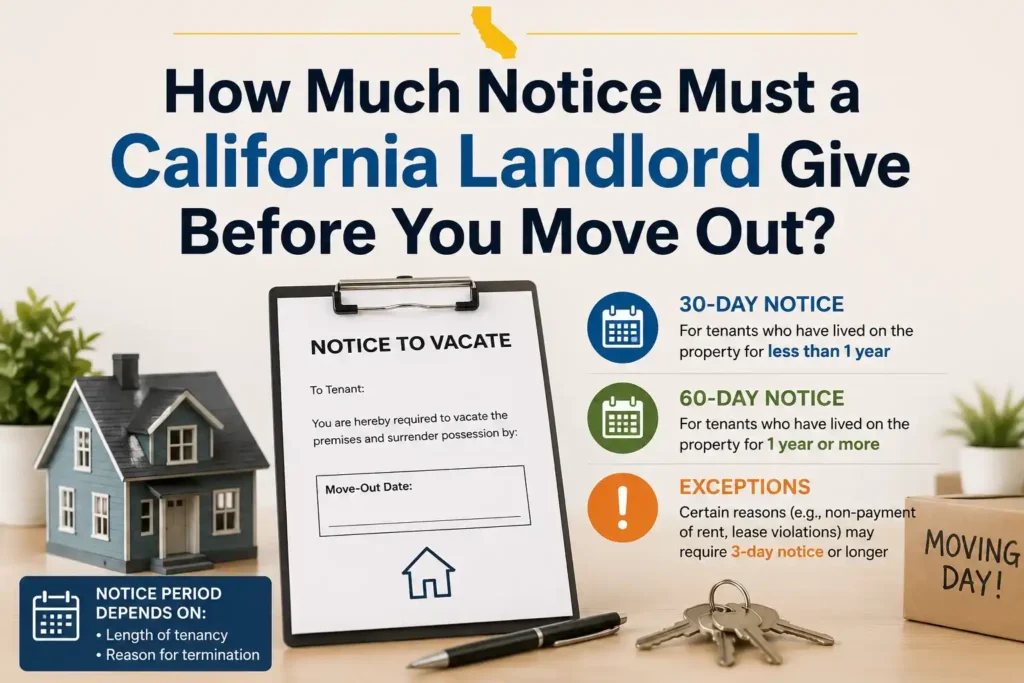
A California 60-day notice to vacate can provide important protections for tenants when a landlord decides to sell. Here is exactly how it works:
- If you have rented the property for less than one year, your landlord must give you at least 30 days’ written notice to vacate.
- If you have rented the property for one year or more, your landlord must give you at least 60 days’ written notice to vacate.
- These rules come directly from California Civil Code Section 1946.1 and apply statewide.
- California law generally requires landlords to follow specific delivery methods. The notice must be in writing and delivered correctly. In most cases, a text message, email, or verbal conversation is not enough.
- The countdown starts when you receive the notice, not when the landlord prepares it.
| Important: Understanding how California tenants can challenge an eviction notice may help you protect your housing rights and avoid unnecessary displacement. |
What Is AB 1482 and How Does It Protect You?
AB 1482, also known as the Tenant Protection Act of 2019, provides important protections for many California renters. If you have lived in the same rental unit for at least 12 months, this law generally gives you two major protections: limits on rent increases and protection against unfair evictions.
First, AB 1482 limits annual rent increases to 5% plus the local Consumer Price Index (CPI), with a maximum cap of 10%. These limits continue to apply even if the property is sold. A new owner generally cannot buy the property and immediately raise the rent beyond what California law allows.
Second, AB 1482 requires a legally valid reason, known as “just cause,” before a protected tenant can be asked to move out. Simply selling the property is usually not enough.
Just cause falls into two categories:
1. At-Fault Just Cause
At-fault just cause is based on the tenant’s actions, such as:
- Non-payment of rent.
- Repeated lease violations.
- Illegal activity on the property.
- Unauthorized subletting.
2. No-Fault Just Cause
No-fault just cause applies when the tenant has done nothing wrong.
- The new owner intends to live in the property as their primary residence.
- A major renovation that cannot be completed safely while tenants are living in the unit.
If a new owner relies on a no-fault reason to end your tenancy, California law generally requires:
- Proper advance notice.
- Relocation assistance equal to one month’s rent or a waiver of the final month’s rent.
- A genuine good-faith reason for the eviction.
For example, if a new owner claims they plan to move into the property but quickly re-rents it to someone else, that could raise serious legal concerns and may give the tenant grounds to challenge the eviction.
Read our complete guide on California’s rent increase limits before signing a new lease or renewing an existing one after a property sale.
Which Properties Are Exempt From AB 1482 Protections?
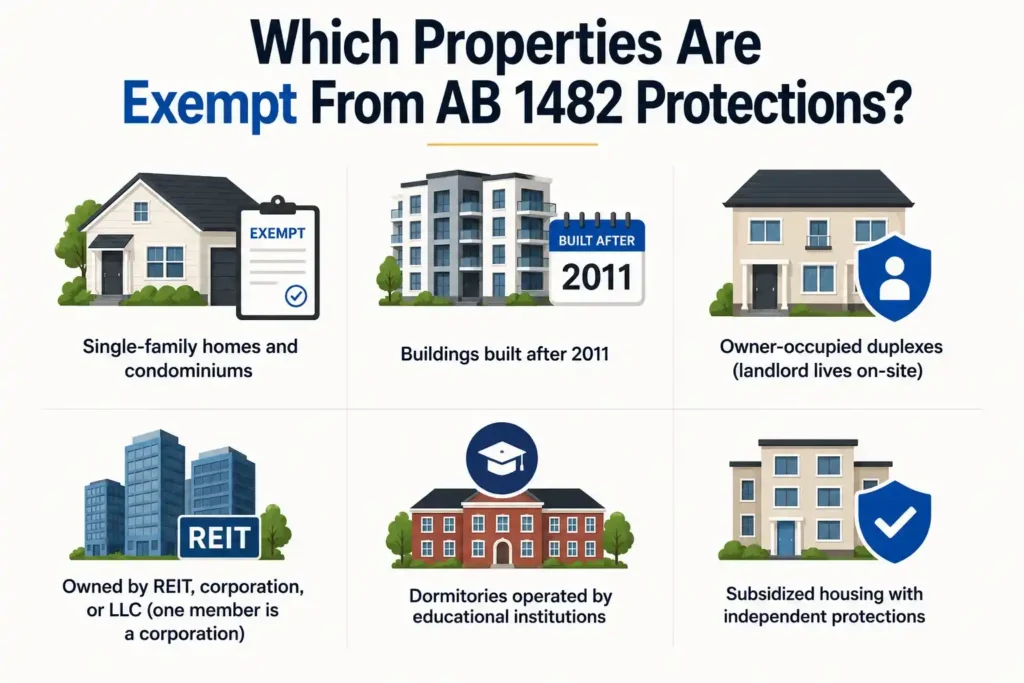
AB 1482 does not cover every rental situation in California, and knowing whether your unit qualifies for protection is critical. The following property types are exempt from the just cause eviction and rent cap rules:
- Single-family homes and condominiums where the landlord has given proper written notice of the exemption at the start of the tenancy.
- Buildings constructed within the last 15 years. This cutoff year changes over time. In 2026, buildings built after 2011 are generally exempt from AB 1482.
- Owner-occupied properties with no more than two units (duplexes where the landlord lives on-site).
- Properties owned by a real estate investment trust (REIT), a corporation, or an LLC where one member is a corporation.
- Dormitories operated by educational institutions.
- Subsidized housing with independent eviction protections already in place.
If you are a landlord, you should read California’s squatter rights laws to reduce the risk of long-term occupancy disputes.
What Happens to Your Security Deposit When a Rental Property Is Sold?
Your security deposit does not disappear when your landlord sells the property. California Civil Code Section 1950.5 lays out exactly what must happen:
- The original landlord must either transfer the full security deposit to the new owner at closing or return it directly to you.
- If the deposit is transferred, you must receive written notice stating the amount transferred, the new owner’s name, and their contact information.
- This notice must be delivered by personal service or first-class mail.
- If the transfer is handled correctly, the new owner becomes responsible for returning the deposit when you eventually move out.
- If the original landlord fails to transfer the deposit and fails to return it to you, both the original landlord and the new owner can be held jointly liable.
What Is Cash for Keys and Should You Accept It?
A cash-for-keys agreement is a situation in which a landlord or new owner offers money to encourage a tenant to move out voluntarily. Unlike an eviction, the tenant is not being forced to leave by a court order. Because the agreement is voluntary, both sides can negotiate the amount of money and the move-out date.
Here is what to know before you sign anything:
- You are not required to accept any cash-for-keys offer.
- The first offer is not always the best one. Many cash-for-keys offers are negotiable.
- A fair cash-for-keys offer is usually higher than standard relocation assistance because the landlord is paying for a faster and smoother move-out.
- Always get the agreement in writing before you vacate or sign anything.
- Review the agreement carefully before signing. Some agreements may ask you to give up future legal claims, so it is smart to hire a tenant rights attorney to check it first.
- Do not vacate the property until you have received the agreed payment in full.
During the home-selling process, landlords often schedule inspections and showings. Understanding tenant privacy rights in California can help ensure those visits comply with state law.
| I have seen tenants accept $500 when they could have negotiated $5,000. Know what your lease rights are worth in this transaction. In tight rental markets like Los Angeles and San Francisco, your occupancy rights have real dollar value. |
How California Tenants Can Respond to Landlord Harassment

Tenant harassment during a property sale is more common than it should be. Some new owners or their agents use pressure tactics to push tenants out before their lease expires or before they are entitled to proper relocation assistance. Knowing what counts as illegal harassment protects you.
Common tenant harassment tactics include:
- Withholding or delaying repairs and maintenance, which is required to make the unit uncomfortable.
- Sending eviction notices without a legal basis.
- Entering your unit without proper 24-hour written notice as required by California Civil Code Section 1954.
- Providing false information about your rights or move-out deadline.
- Threats or intimidation, whether in person or in writing.
If you believe a landlord or new owner is harassing you, start documenting everything immediately.
- Save text messages, emails, letters, and notices.
- Take photos or videos when appropriate.
- Keep copies of repair requests and responses.
- Document any unauthorized entries into the unit.
- Maintain a written timeline of what happened and when.
- Report violations to your local housing agency if necessary.
- Consult a tenant rights attorney if the harassment continues.
The more evidence you collect, the easier it will be to protect your rights and challenge unlawful conduct.
If you eventually move out, reviewing California’s security deposit rules can help you avoid unfair deductions and protect your refund.
30-Day Action Plan for Tenants After a Property Sale
If you just found out your landlord is selling the property, here is exactly what to do in the next 30 days:
- Review your lease carefully. Check the lease end date, notice requirements, and any clauses related to a property sale.
- Check whether your property is covered by AB 1482, and verify the building’s age and ownership structure.
- Check your city’s local rent ordinance, contact your local Rent Board or housing authority if you are unsure.
- Document the current condition of your unit with date-stamped photos and video.
- Get written confirmation of who currently holds your security deposit and in what amount.
- If you receive a notice to vacate, verify that it meets California legal requirements: written, properly dated, properly served, and correct notice period.
- Do not vacate or sign any agreement until you understand your tenant rights in California.
- Contact a tenant rights attorney or local tenant organization if you receive any pressure to leave, a cash-for-keys offer, or an eviction notice.
- Keep copies of every piece of written communication from this point forward.
- If relocation assistance is owed to you, do not accept less than what California law requires.
If legal action becomes necessary, understanding contingency-based legal representation may help you find an attorney without high upfront costs.
Frequently Asked Questions
Q: Can I refuse to let buyers view the property?
You cannot refuse entry entirely, but California Civil Code Section 1954 requires your landlord to give you at least 24 hours’ written notice before each showing. You can set reasonable conditions on the timing, and you are not required to be present.
What Is a 1031 Exchange, and Can It Affect My Rights as a Tenant?
A 1031 exchange is a real estate transaction that allows a property owner to sell one investment property and buy another while postponing certain taxes. While the process mainly benefits the property owner, it usually does not affect a tenant’s legal rights. Your lease generally remains valid, and California tenant protection laws still apply.
Do California Tenants Have a Right of First Refusal When a Landlord Sells a Property?
Usually not. California law generally does not require a landlord to offer a rental property to the current tenant before selling it to another buyer. However, some cities, such as Oakland, San Francisco, and Berkeley, have local rules that may provide limited purchase rights in certain situations. These protections typically apply only to specific property types or sale circumstances.
Can a Landlord Use the Ellis Act to Evict Tenants Before Selling a Property?
The Ellis Act allows a landlord to permanently stop renting out a property and leave the rental business. Simply wanting to sell a rental property is usually not enough to use the Ellis Act. In most cases, tenants cannot be removed under the Ellis Act just because the property is being sold. If a landlord claims they are using the Ellis Act, make sure they follow all notice and relocation assistance requirements.
What Happens if the Property Is Sold Through Foreclosure?
A foreclosure happens when a property owner falls behind on mortgage payments, and the lender takes control of the property. The lender may then sell the property to recover the unpaid loan balance. If you are renting the home, this does not automatically mean you must move out. In many cases, the new owner must still follow California tenant laws and provide proper notice.
Final Thoughts
Finding out your landlord is selling the property you rent can feel destabilizing. But the law is genuinely on your side in California, and you have real, enforceable tenant rights at every stage of this process.
Whether the new owner wants you gone quickly, is offering you a cash for keys agreement, or is sending notices that do not look quite right, the steps are the same: know your lease, know your city’s rules, document everything, and do not sign or vacate anything without understanding exactly what you are agreeing to.
If you are unsure about your specific situation, the best thing you can do is consult a California tenant rights attorney. Many offer free initial consultations, and local tenant rights organizations can help you understand your options at no cost.
Also read: Legal options for renters dealing with mold
Sources and References
The following sources were used to verify legal information in this article:
- California Courts Guide to Residential Tenants’ and Landlords’ Rights and Responsibilities
- Los Angeles Housing Department Rent Stabilization Ordinance (RSO)
- San Francisco Rent Board Tenant Protections Overview
- Oakland Rent Adjustment, Program Just Cause, and TOPA
- California Department of Consumer Affairs Landlord-Tenant Guide
- https://leginfo.legislature.ca.gov/
Disclaimer: This article is for general informational purposes only and does not constitute legal advice. Landlord-tenant laws can vary based on your specific situation, so consult a qualified California attorney for legal guidance.