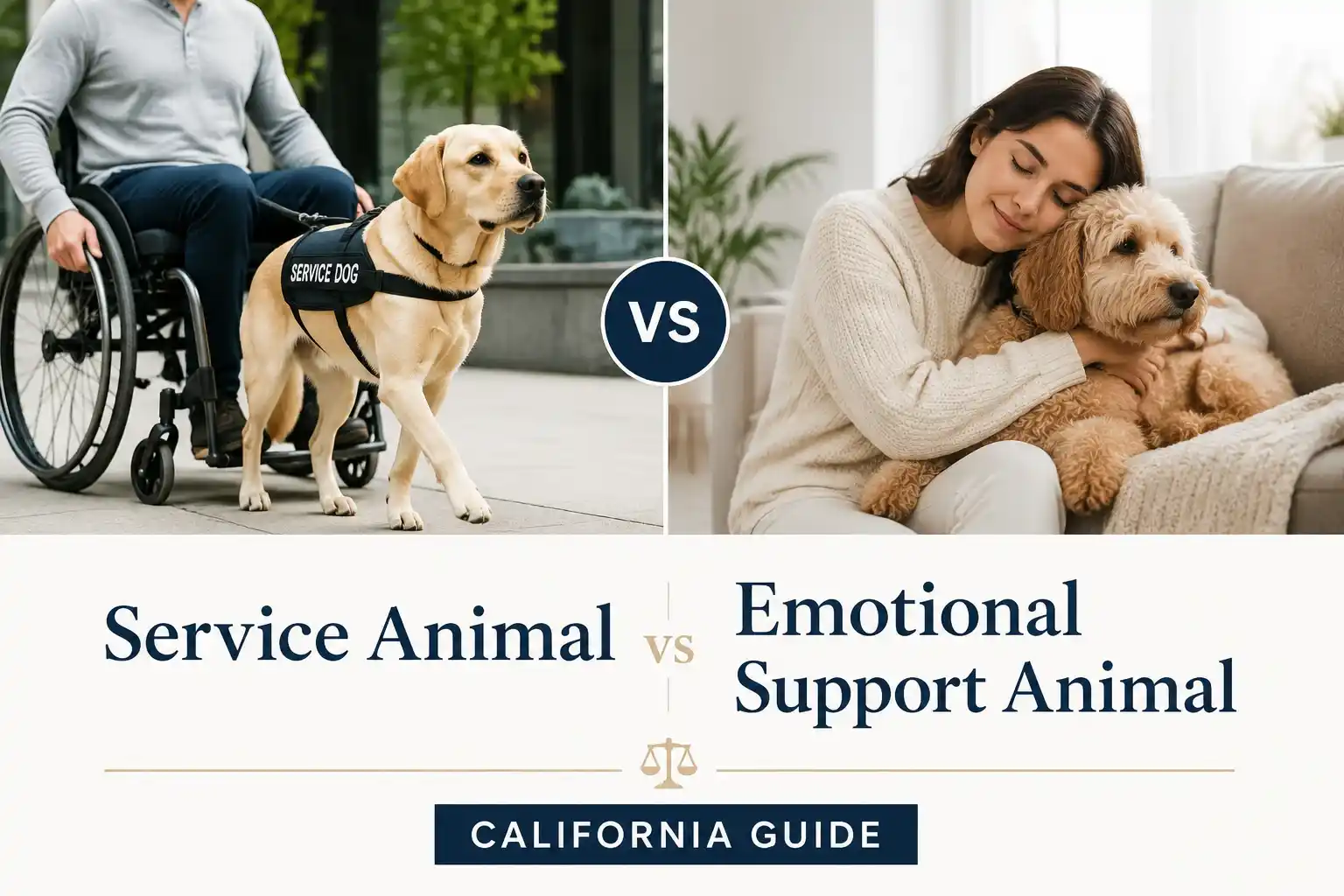
Service Animal vs. Emotional Support Animal in California: The Legal Differences Explained
Quick Answer: A service animal is trained to perform disability-related tasks and usually has broader public access rights under the ADA. An emotional support animal provides comfort without task-specific training, so its protections usually apply mainly to housing. California does not require online registration, certification, or ID cards to prove service animal or ESA status.
Two animals may look identical inside a California rental property, but housing rules may place them in very different legal categories. That distinction matters for landlords who need to comply with fair housing duties, renters who rely on disability-related support, and property owners who want to prevent misuse without crossing legal lines.
Service Animal vs. Emotional Support Animal in California often turns on the animal’s role, training, disability-related need, documentation, behavior, and the housing context. Simple assumptions can create bigger problems because real disputes usually involve lease terms, pet policies, accommodation requests, complaints, and timing.
This guide explains the key differences in clear, practical language so you can approach animal-related housing issues with confidence, caution, and a better understanding of your options.
What Counts as a Service Animal Under California and Federal Law?
Under the ADA, a service animal usually means a dog that has been individually trained to perform work or tasks for a person with a disability. This makes a service animal different from an emotional support animal, which may provide comfort or support but does not perform a trained disability-related task.
Understanding California ESA tenant rights helps renters know their protections and how to request an ESA accommodation. California law also focuses on trained disability-related tasks, including labels, vests, online certificates, or ID cards. A service dog may be trained to help with different disabilities, depending on the person’s needs. For example, a service dog may:
- Guide a person who is blind or has low vision.
- Alert a person who is deaf or hard of hearing.
- Assist with mobility, balance, or wheelchair-related tasks
- Retrieve dropped items or open doors.
- Alert to seizures, blood sugar changes, fainting episodes, or other medical events.
- Help the person stay safe during a disability-related episode.
- Turning on lights.
- Offering tactile stimulation.
The dog does not need to perform every possible task. It only needs to perform trained work or tasks that directly relate to the handler’s disability.
Service Animal vs Emotional Support Animal in California: Key Difference
The line between a service animal and an emotional support animal matters because it can affect how a housing request, a public access issue, or a pet policy should be handled. The main question is whether the animal performs a trained task or provides emotional support.
| Comparison Point | Service Animal | Emotional Support Animal |
|---|---|---|
| Main legal role | Performs trained work or tasks for a person with a disability | Provides disability-related emotional support or comfort |
| Training | Must have task-specific training | Does not need task-specific training |
| ADA public access | Usually covered if ADA requirements are met | Not treated as a service animal under the ADA |
| Housing context | May be handled as a disability accommodation | May be handled as a disability accommodation |
| Key question | What trained task does the animal perform? | Is there a disability-related need in housing? |
If you want a deeper breakdown of how landlords should handle ESA requests and documentation issues, read our full guide on California Landlord Rules for ESA vs Pet.
Do Service Animals Have Public Access Rights in California?
Yes. Service animals generally have public access rights in California, but emotional support animals do not get the same ADA public access rights.
A trained service dog may usually go with its handler into places open to the public, including:
- Restaurants, cafes, and bars.
- Hotels, motels, and other lodging places.
- Grocery stores, retail stores, and shopping centers.
- Banks, offices, and professional service locations.
- Hospitals, clinics, and medical offices.
- Schools, colleges, and public education settings.
- Government buildings and public agencies.
- Courthouses and public meeting spaces.
- Public transportation, stations, and terminals.
- Theaters, stadiums, museums, and entertainment venues.
- Parks, recreation areas, and public facilities.
- Rental offices, leasing offices, and housing-related public areas.
Businesses and public places generally cannot deny entry just because they have a no-pet policy. A service animal is not treated as a regular pet when it meets the legal requirements.
However, access still has limits. The animal must:
- Remain under the handler’s control.
- Be housebroken and able to avoid bathroom accidents in public places. If the dog is not housebroken, a business or property may have grounds to remove the dog from that area.
- Not create a direct threat to health or safety.
- Staff cannot demand online registration, certification, a vest, or an ID card.
- Staff may ask limited questions only when the service animal’s role is not obvious.
The simple rule is this: a trained service animal can usually enter public areas where customers, guests, clients, or members of the public are allowed.
Sample Tenant Accommodation Request Letter for Service or ESAs (Free Template)
[Date]
[Tenant Name] [Tenant Address] [City, State, ZIP]
[Landlord/Property Manager Name] [Property Management Company, if applicable] [Address] [City, State, ZIP]
Re: Request for Reasonable Accommodation – [Unit Address]
Dear [Landlord/Property Manager Name],
This letter serves as a formal request for a reasonable accommodation under the Fair Housing Act and California’s Fair Employment and Housing Act. This request concerns a disability-related need for a [service animal/emotional support animal].
Attached is a letter from my licensed health care provider, dated [date], confirming my disability-related need for this accommodation. Consistent with applicable privacy protections, the documentation confirms the need for the accommodation without disclosing my specific diagnosis.
Please consider this a request for the animal to be permitted in the unit as a reasonable accommodation, without requiring a pet deposit or pet rent, consistent with applicable law.
Any additional information permitted under applicable law can be provided upon request. Please confirm receipt of this request and let me know if any further information is needed to process it.
Thank you for the time and attention given to this matter.
Sincerely, [Tenant Name]
Read our detailed guide on Are ESAs exempt from pet rent in California?
How to Request Disability Documentation from Tenants: Free Landlord Letter Template
[Date]
[Landlord/Property Manager Name]
[Property Management Company, if applicable]
[Address]
[City, State, ZIP]
[Tenant Name]
[Tenant Address]
[City, State, ZIP]
Re: Request for Documentation – Reasonable Accommodation Request ([Unit Address])
Dear [Tenant Name],
Thank you for your accommodation request regarding your emotional support animal. Because the disability-related need is not readily apparent, California and federal law permit us to request reasonable documentation confirming that need.
Please provide a letter from a licensed health care provider one who has an established relationship with you confirming that the animal is necessary because of a disability-related need. We are not requesting your specific diagnosis, medical records, or other unrelated medical information.
Once we receive this documentation, we will review your request and respond promptly. If you have any questions about what is needed, please feel free to reach out.
Best regards,
[Landlord/Property Manager Name]
Bottom Line
Whether an animal qualifies as a service animal or an emotional support animal shapes everything that follows, where it’s allowed to go, what rights it carries, and what documentation, if any, can legally be requested. Tenants and landlords who understand this distinction from the start can resolve accommodation requests faster, avoid unnecessary friction, and stay on the right side of California and federal law.
If a landlord unlawfully denies a reasonable accommodation request, tenants may have grounds for a fair housing complaint. Many attorneys handle these cases on a contingency-fee basis, meaning you pay nothing unless the case succeeds.
Frequently Asked Questions
What questions can a housing provider ask about a service animal?
A housing provider may ask limited questions, such as whether the animal is required because of a disability and what work or task the animal has been trained to perform. They cannot ask the individual to disclose their disability, provide unnecessary personal details, or make the animal demonstrate its task.
Can a service animal be left alone inside the unit?
A service animal should not be left alone inside the unit without prior approval. The animal must remain under the handler’s control and follow reasonable property rules related to safety, cleanliness, and access to shared or restricted areas.
Who Is Eligible to Use a Service Dog in California?
A person is eligible to use a service dog in California if they have a disability and the dog is individually trained to perform a specific task related to that disability. The disability may be physical, sensory, psychiatric, intellectual, or another mental disability.
If my service dog looks like a normal pet, how can anyone know it is legitimate?
Under the ADA, a service dog is not required to wear a vest, ID tag, special harness, or certification papers. What makes the dog legally legitimate is not its appearance, but whether it is individually trained to perform a disability-related task. When the need is not obvious, staff may ask only limited questions about whether the dog is required because of a disability and what work or task it has been trained to perform.
Can a service dog help someone who does not look disabled?
Yes. Many disabilities are not visible. A person may have a psychiatric, neurological, sensory, medical, or other disability that is not obvious to others. In California and under the ADA, the focus is not on whether the disability can be seen, but whether the dog is trained to perform a task related to that disability.
Can a service dog be denied access because another person is afraid of dogs?
Generally, no. Fear of dogs is not a valid reason to deny access to a person using a service dog. If another person has fear, allergies, or discomfort, the better approach is to accommodate both people when possible, such as by creating distance or offering separate seating.
How does service dog support work when more than one household member has a disability?
A service dog is usually trained to assist one specific person with a disability. However, in some situations, one dog may support more than one household member if it is trained to perform clear disability-related tasks for each person.
References
- U.S. Department of Justice (ADA): Service Animals (Federal Law)
- U.S. Department of Transportation: Traveling by Air with Service Animals
- California Civil Rights Department: Disability Rights in Housing (Fair Employment and Housing Act)
Disclaimer: The content on this blog is for general informational purposes only and does not constitute legal advice. Reading this blog does not create an attorney-client relationship; for advice about your specific situation, please consult a licensed attorney in your jurisdiction.